Wall Street Is Coming for Stablecoins: 21 Banks Plan a Digital Dollar
Goldman Sachs, Bank of America, Citi, Deutsche Bank and other global financial institutions are backing a new dollar stablecoin venture. The move could reshape digital payments, challenge Tether and Circle, increase demand for US Treasuries and push blockchain deeper into mainstream finance.

Wall Street Is Coming for Stablecoins: 21 Banks Plan a Digital Dollar
Crypto spent years trying to disrupt the banks.
Now the banks want their own crypto rails.
A group of 21 major global financial institutions has committed to establish a new company later this year with plans to launch a US dollar-denominated stablecoin in the first half of 2027. Goldman Sachs, Bank of America, Citi, Wells Fargo, Deutsche Bank, UBS, TD Bank and Scotiabank are among the institutions involved.
There is an important distinction behind the headline. The consortium includes 21 financial institutions rather than literally 21 commercial banks, with firms such as Fidelity Investments, WisdomTree and other financial companies participating alongside major banks.
That does not make the announcement less important. If anything, the diversity of the participants shows how quickly stablecoins are moving beyond their original role as a tool for crypto traders.
The new venture wants to use digital money for cross-border payments, institutional settlement, digital-asset settlement and potentially retail transactions. More importantly, the proposed tokens are intended to operate on public blockchains while combining that infrastructure with bank-level compliance, governance and risk management.
The question is no longer whether Wall Street is interested in blockchain.
The more interesting question is:
What happens when the companies that dominate traditional finance begin competing directly for the digital-dollar economy?
What Is the New Bank Stablecoin Plan?
The 21 institutions intend to establish a new company in the second half of 2026, subject to closing conditions. The company's name has not yet been announced.
Its initial product would be a US dollar-denominated stablecoin, targeted for launch during the first half of 2027. The group says it eventually wants to expand into additional G7 currencies, with a euro-denominated stablecoin listed as a priority.
The project grew considerably over the past year. An original group of 10 banks announced in October 2025 that they were exploring a 1:1 reserve-backed digital payment asset, and that coalition has now expanded to 21 participants.
Who Is Involved? Region Participating Institutions United States Bank of America, Capital One, Citi, Fidelity Investments, Goldman Sachs, PNC, Wells Fargo, WisdomTree Canada Scotiabank, TD Bank Group Europe Santander, BBVA, Commerzbank, Crédit Agricole, Deutsche Bank, Lloyds, Rabobank, UBS Japan MUFG Bank Middle East Sirius International Holding Africa Standard Bank
This is not one bank experimenting with blockchain in a sandbox.
It is a multinational attempt to create shared digital-money infrastructure across some of the largest financial markets in the world.
What Is a Stablecoin?
A stablecoin is a digital token designed to maintain a relatively stable value, usually by being pegged to a traditional currency.
For a US dollar stablecoin, the basic goal is straightforward:
1 token ≈ $1
Unlike Bitcoin, which can move several percentage points in a day, a properly functioning dollar stablecoin attempts to remain close to $1 through reserves, redemption mechanisms and market activity.
That makes stablecoins useful for moving money between exchanges, settling trades, sending cross-border payments and holding dollar exposure without necessarily using a traditional bank account for every transaction.
The proposed Wall Street stablecoin is expected to be 1:1 reserve-backed, following the model the original consortium described in 2025. The institutions also say the initiative intends to comply with the US GENIUS Act and Europe's MiCA framework where applicable.
Why a Bank Stablecoin Matters Now
Stablecoins are not new.
What is changing is who wants to issue them.
Crypto-native companies such as Tether and Circle built enormous businesses while much of traditional finance remained cautious about digital assets. Now that the market has proven there is demand for tokenized dollars, banks increasingly want exposure to the same infrastructure.
The numbers explain why.
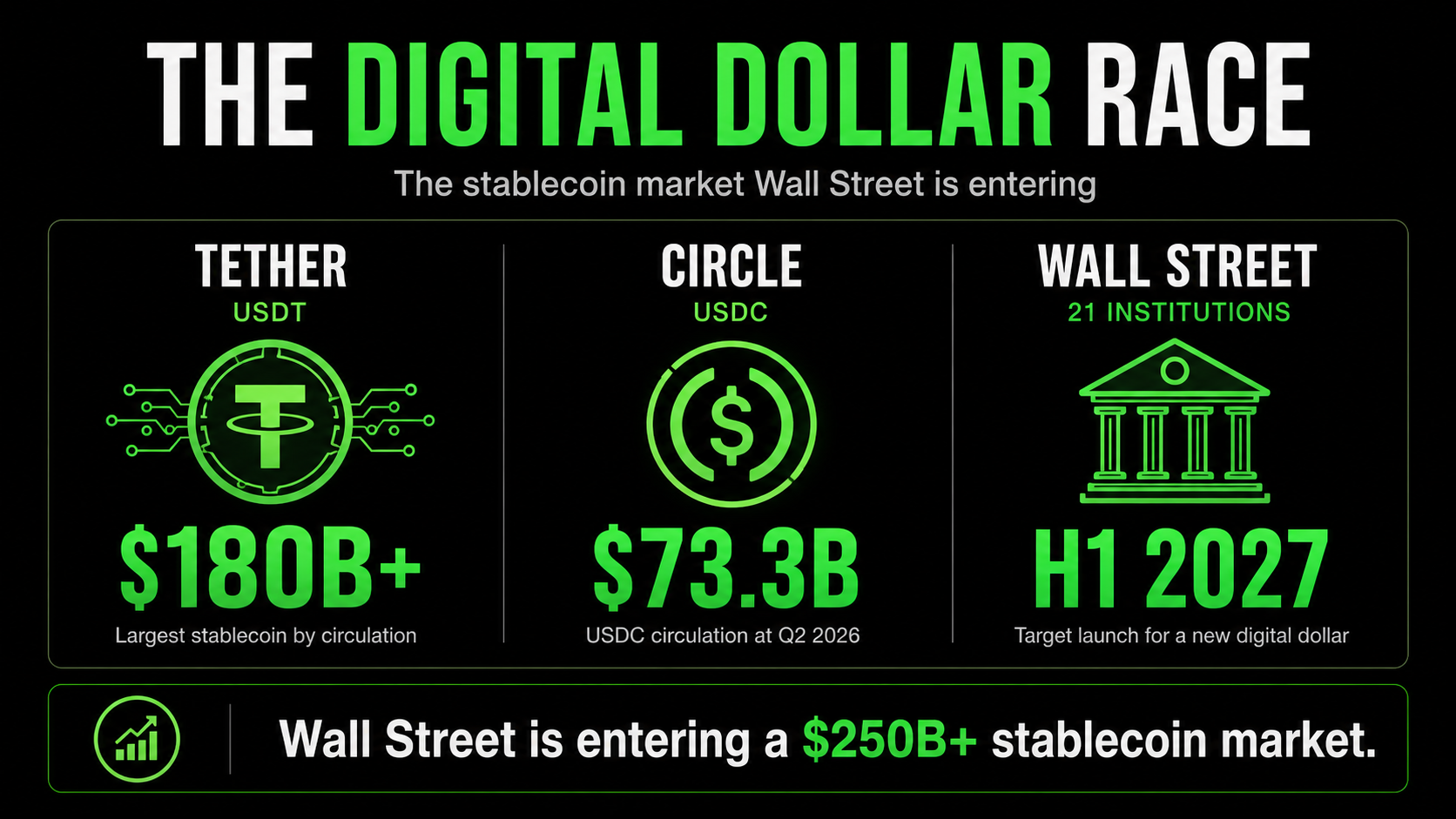
Tether and Circle Already Control More Than $250 Billion
Tether's USDT remains the dominant dollar stablecoin.
Tether reported approximately $183 billion of token-related liabilities as of March 31, 2026, which provides a close proxy for the scale of USDT then in circulation. Reuters reported this week that more than $180 billion of dollar-pegged Tether tokens remain outstanding.
Circle's USDC ended Q2 2026 with:
Circle Q2 2026 Metric Result USDC in circulation $73.3B YoY circulation growth +19% Q2 on-chain transaction volume $14.8T Transaction volume growth +151% YoY Revenue + reserve income $701M Revenue growth +7% YoY Adjusted EBITDA $143M
USDT and USDC alone therefore represent more than $250 billion of tokenized dollar value.
That is the market Wall Street is entering.
Why Banks Want In
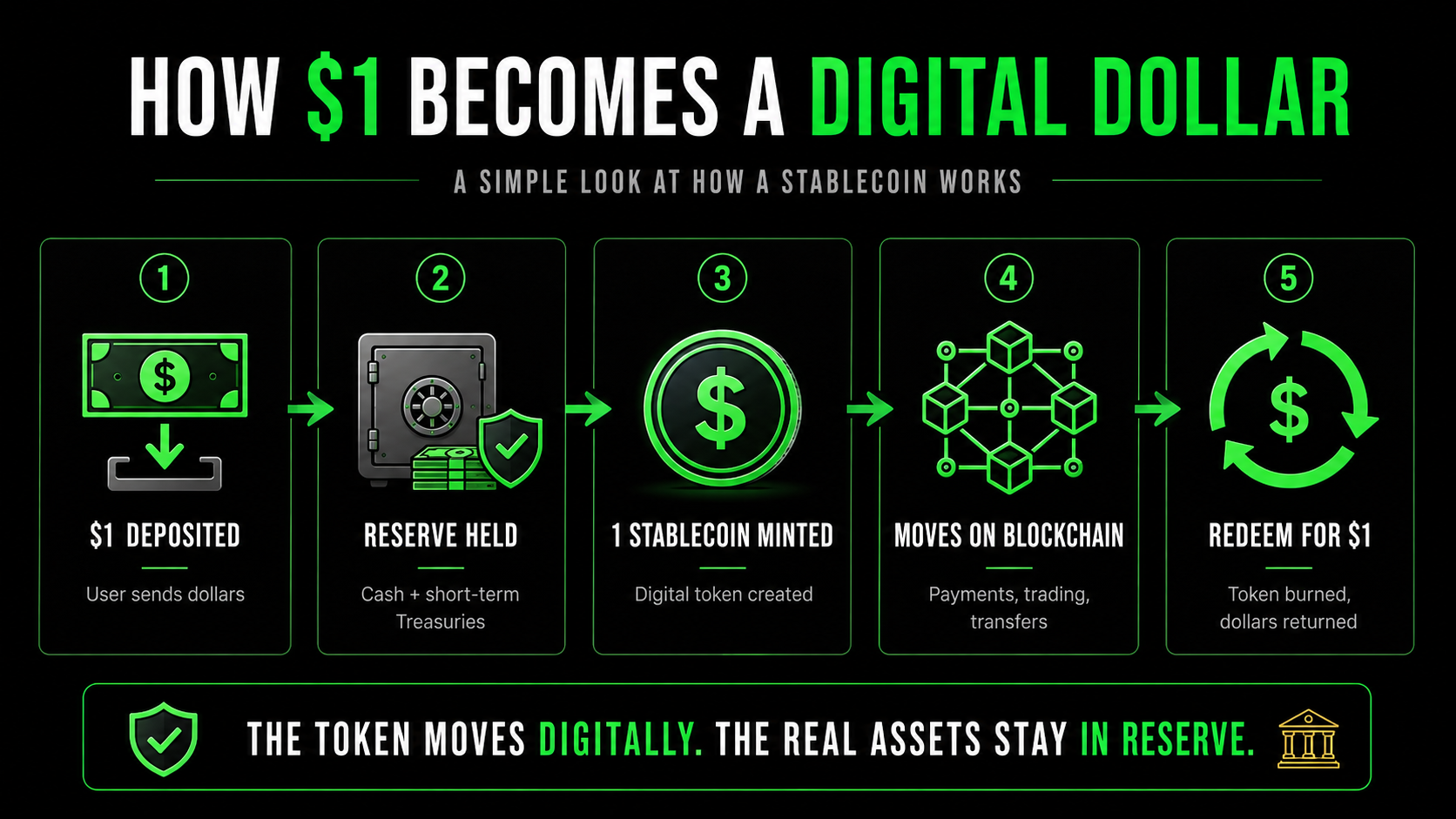
Stablecoins can look simple from the outside. A customer gives an issuer $1, the issuer creates one token, and that token circulates digitally.
The economics become much more interesting when tens or hundreds of billions of dollars are involved.
Stablecoin issuers generally invest reserves in highly liquid assets such as cash, Treasury bills and similar short-duration instruments. Those reserves can earn interest while the digital token continues circulating through the economy.
Tether illustrates how powerful that model can become.
Tether Made More Than $10 Billion in 2025
Tether reported more than $10 billion in net profit during 2025, along with approximately $6.3 billion in excess reserves.
Its total direct and indirect exposure to US Treasuries reached a record:
$141 billion
by the end of 2025.
In Q1 2026 alone, Tether reported approximately:
$1.04 billion in net profit
and an excess reserve buffer of:
$8.23 billion.
That is an extraordinary business built around something that is intentionally designed to remain worth $1.
Banks have noticed.
Stablecoins Are Becoming a Treasury Market Story
This is where crypto starts connecting directly to macro markets.
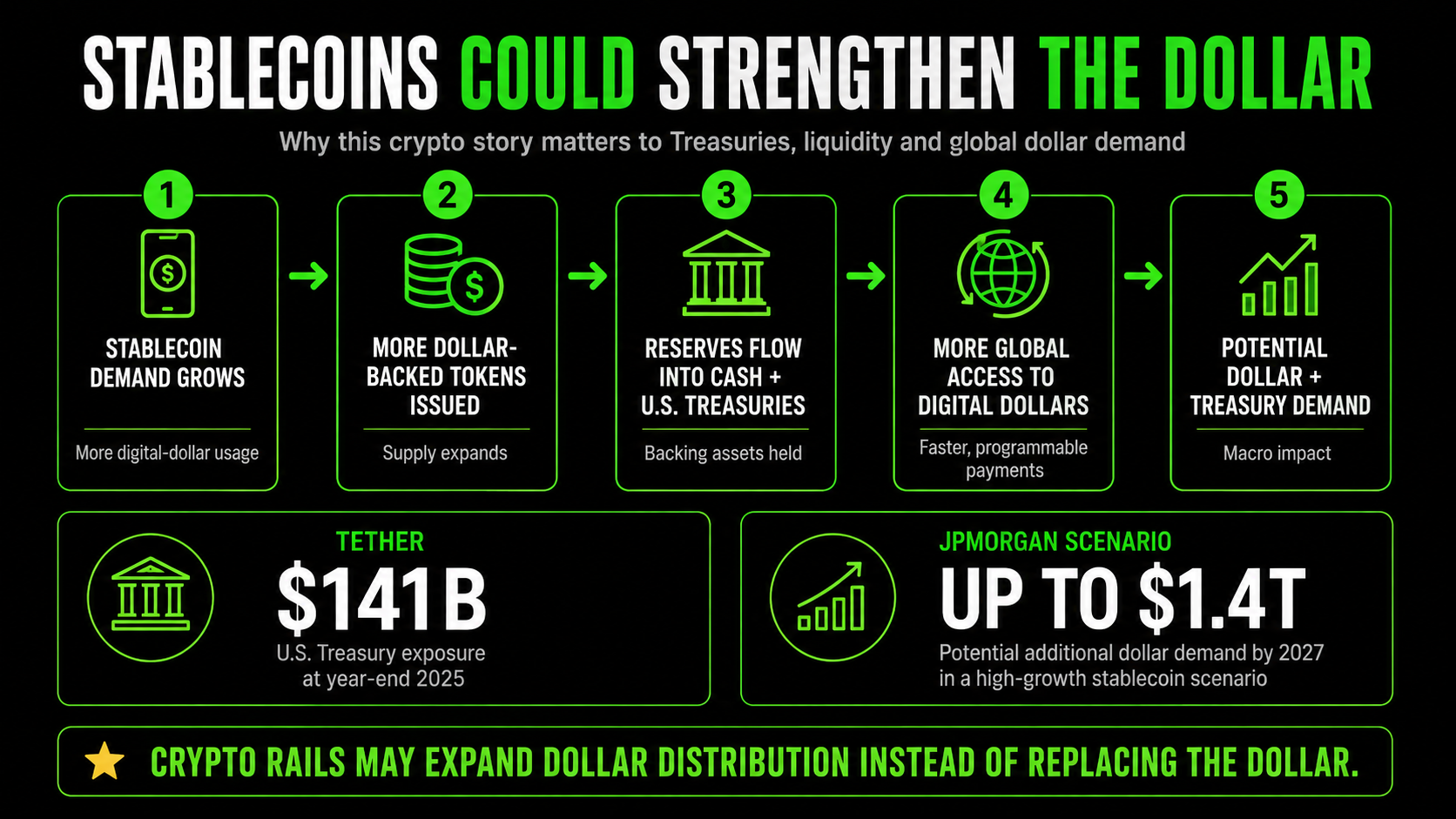
Stablecoin reserves need somewhere to go. In the United States, short-term Treasury securities have become one of the most important destinations because they offer liquidity, government backing and interest income.
That means stablecoin growth can potentially create additional demand for US government debt.
JPMorgan previously estimated that rapid stablecoin adoption could generate as much as:
$1.4 trillion in additional US dollar demand by 2027
under a high-growth scenario.
At the time of JPMorgan's analysis, the overall stablecoin market was roughly $260 billion. The bank examined a scenario in which it could eventually reach approximately $2 trillion, while noting that such aggressive growth is far from guaranteed.
That leads to an interesting possibility.
Crypto technology may not weaken the US dollar.
It could actually make the dollar more accessible globally.
Digital Dollars Could Strengthen Dollar Dominance
Think about someone outside the United States who wants exposure to dollars.
Traditionally, they may need:
a local bank,
a foreign-exchange transaction,
a US correspondent bank,
or access to dollar-denominated investments.
A dollar stablecoin can potentially compress much of that process into a digital wallet and blockchain transaction.
If billions of people eventually gain easier access to digital dollars, demand for the underlying currency could increase.
JPMorgan noted that roughly 99% of stablecoin supply was dollar-linked when it published its analysis. That dominance suggests crypto's digital-money revolution has so far looked much more like dollarization on blockchain rails than the end of the dollar.
That is one of the biggest misconceptions around stablecoins. Blockchain does not automatically mean replacing fiat currency. Sometimes blockchain simply creates a new distribution system for it.
The GENIUS Act Changed the US Stablecoin Market
One reason banks are moving now is that the regulatory environment has become clearer.
President Donald Trump signed the GENIUS Act into law on July 18, 2025, creating the first comprehensive federal framework specifically governing US payment stablecoins.
Among other requirements, the framework requires payment stablecoins to be backed by liquid assets such as US dollars and short-term Treasuries. Issuers must also provide regular reserve disclosures.
That matters enormously for large financial institutions.
Banks generally dislike regulatory ambiguity.
Once there is a defined framework explaining who can issue a stablecoin, how reserves must be managed and what compliance standards apply, the risk calculation changes.
The new 21-member venture explicitly says it intends to be GENIUS Act compliant.
Europe Has MiCA, and Wall Street Wants In There Too
Europe has already built its own regulatory framework through the Markets in Crypto-Assets Regulation, better known as MiCA.
MiCA creates common EU rules covering crypto-asset issuers, service providers, stablecoin-like asset-referenced tokens and electronic-money tokens. The framework includes requirements around authorization, disclosure, supervision and financial stability.
The Wall Street consortium says it intends to comply with MiCA where applicable.
That becomes particularly important because the group's long-term roadmap specifically identifies a euro stablecoin as its next priority after the dollar product.
Europe Is Already Building a Rival Stablecoin Network
The 21-institution venture will not have Europe to itself.
A separate initiative called Qivalis has expanded to 37 financial institutions and is working toward its own euro-denominated stablecoin. Reuters reports that the group includes major European financial institutions and plans to launch its token before the Wall Street consortium's 2027 dollar launch.
Some institutions are even participating in more than one initiative.
That suggests the industry has not yet settled on a single stablecoin model.
Instead, we could be moving toward an ecosystem containing:
Digital Money Model Examples Crypto-native stablecoins USDT, USDC Bank consortium stablecoins New 21-member USD venture Regional bank stablecoins Qivalis euro project Individual bank tokens Societe Generale and others Tokenized bank deposits Emerging institutional model Central bank digital currencies Government-issued digital money
The competition may ultimately be less about whether money becomes digital and more about which digital money people choose to use.
Can Wall Street Actually Beat Tether?
Launching a stablecoin is relatively easy.
Creating liquidity and network effects is much harder.
Tether's advantage is not simply that USDT exists. It is deeply integrated across crypto exchanges, trading pairs, wallets, payment networks and emerging markets.
Reuters points to Societe Generale as a useful warning.
The French bank became one of the first major traditional banks to issue a dollar-backed stablecoin, yet its token had only around:
$12.5 million in circulation
according to Reuters' latest reporting.
Compare that with Tether's more than $180 billion.
The difference is roughly four orders of magnitude.
Distribution May Matter More Than Technology
This is why the 21-bank coalition is interesting.
The institutions already have customers, corporate relationships, global payment networks, compliance teams, capital-markets operations and enormous distribution.
What they do not automatically have is crypto-native liquidity.
That will create several important questions before the 2027 launch.
Will exchanges list the stablecoin?
Will market makers provide deep liquidity?
Which public blockchains will support it?
How fast will minting and redemption work?
Will retail investors be able to access it directly?
Will corporations use it for settlements?
Will banks incentivize customers to use it instead of USDT or USDC?
Those details may ultimately matter more than the token's name.
What Does This Mean for Circle and $CRCL?
Circle is probably the publicly traded company with the clearest direct exposure to this story.
USDC circulation reached $73.3 billion at the end of Q2, up 19% YoY, while quarterly on-chain transaction volume surged 151% to $14.8 trillion. Circle generated approximately $701 million in revenue and reserve income during the quarter.
That is strong growth.
But a consortium containing Bank of America, Citi, Goldman Sachs, Wells Fargo, Deutsche Bank and UBS represents a credible future competitor.
The immediate impact on Circle should not be overstated because the new token is not expected until 2027. USDC also has existing liquidity, integrations, exchange support and infrastructure that a new entrant will need time to replicate.
For investors watching $CRCL, however, the competitive question just became more important.
Circle Is Building Its Own Infrastructure Moat
Circle is not standing still.
The company says its upcoming Arc public mainnet is scheduled for September 16, 2026, with support for privacy tools, programmable finance, tokenized real-world assets and more than 100 ecosystem and institutional builders already involved.
That tells us where the competition is going.
It is not simply:
Which company has the largest stablecoin?
It is increasingly:
Who controls the financial infrastructure built around the stablecoin?
Payments, tokenized assets, settlement, lending, institutional trading and programmable finance could become the larger prize.
What Does This Mean for Tether?
Tether faces a different competitive equation.
It is privately held, enormously profitable and significantly larger than USDC by circulating supply.
Its biggest advantage is global distribution, particularly in markets where access to traditional US banking infrastructure can be difficult.
A bank-issued stablecoin could eventually challenge Tether in regulated institutional markets, where corporations may prefer a token backed by recognizable global banks.
But that does not necessarily mean the same product will quickly displace USDT in crypto-native or emerging-market activity.
The stablecoin market may be large enough for multiple winners.
What Does a Bank Stablecoin Mean for Bitcoin?
A major bank stablecoin is not automatically bullish or bearish for Bitcoin.
Bitcoin and stablecoins serve fundamentally different purposes.
Bitcoin is a scarce, floating-price digital asset with a fixed maximum supply.
A bank stablecoin is designed to remain worth approximately $1.
What stablecoins can do is make it easier for money to move into and around digital-asset markets. Greater stablecoin liquidity can improve settlement infrastructure, trading access and the movement between fiat and crypto.
So the more reasonable Bitcoin thesis is indirect:
better digital-dollar infrastructure could make crypto markets easier to access.
That does not mean someone buying a bank-issued stablecoin will automatically buy BTC.
What About Ethereum and Other Blockchains?
This part is potentially more interesting.
The consortium specifically says the original stablecoin project was designed to create digital money available on public blockchains.
It has not yet announced which blockchain or blockchains the new token will use.
That distinction matters.
If major banks eventually deploy significant settlement volume on Ethereum or another public network, that could increase institutional activity on the selected chain.
But until the consortium names a blockchain, claims that this announcement is specifically bullish for $ETH, $SOL or any other token would be speculation.
The infrastructure decision is something traders should watch closely.
Stablecoins vs. Tokenized Bank Deposits
Not everyone in traditional finance believes stablecoins should become the dominant form of digital money.
Bank for International Settlements General Manager Pablo Hernández de Cos argued at Jackson Hole that stablecoins are not yet a credible payment solution at global scale. He highlighted concerns around bank funding, monetary sovereignty, interoperability, financial stability and money laundering.
The BIS sees tokenized commercial-bank deposits as a potentially more natural bridge between blockchain technology and the existing monetary system.
That creates an important philosophical divide.
A stablecoin moves money onto a new token.
A tokenized deposit attempts to modernize the money that already exists inside banks.
The technology may look similar from the outside, but the monetary architecture is different.
Could Stablecoins Pull Money Out of Banks?
This is one of the biggest risks central banks are watching.
Imagine a customer holds $50,000 in a traditional bank account.
Now imagine that customer converts $20,000 into stablecoins.
If that happens across millions of customers, banks could lose deposits.
Those deposits are important because they help fund lending.
If stablecoins cause significant deposit migration, banks might need to compete harder for funding or rely more heavily on wholesale markets.
The BIS has specifically warned that widespread stablecoin adoption could raise bank funding costs.
A bank-controlled stablecoin might partly solve that problem by allowing banks to participate directly rather than watching deposits migrate to outside issuers.
That may be one of the most important strategic reasons Wall Street is entering the market.
The G20 Just Gave Digital Assets Another Legitimacy Boost
The timing of the announcement is notable.
On September 1, G20 finance ministers and central-bank governors released a new statement recognizing that digital financial innovation, including digital assets, can support broad-based economic growth.
The group committed to developing clearer pathways for responsible digital-asset innovation while maintaining financial stability. It also specifically highlighted future Financial Stability Board work involving global stablecoin arrangements and reaffirmed efforts to improve cross-border payments.
This is not an endorsement of every cryptocurrency or stablecoin.
It is something more structural.
Major governments are increasingly discussing digital assets as a component of the global financial system rather than simply an industry sitting outside it.
Stablecoins Could Become the Bridge Between TradFi and Crypto
For years, discussions about crypto often framed the industry as a competitor to traditional finance.
Bitcoin versus banks.
DeFi versus Wall Street.
Crypto versus fiat.
The stablecoin story is evolving differently.
Traditional finance is increasingly taking blockchain infrastructure and integrating it into existing financial institutions.
That means the future may look less like:
Crypto replaces banks
and more like:
Banks begin operating on crypto-style rails.
That may sound less revolutionary.
Economically, it could be much bigger.
Cross-Border Payments Could Be the Killer Use Case
International payments remain expensive and complicated because money can move through multiple institutions before reaching its destination.
A corporate payment may involve a sending bank, correspondent bank, currency conversion, receiving bank and settlement delays.
Blockchain-based dollars can potentially simplify part of that process.
The new consortium specifically identifies cross-border payments as one of its intended use cases.
That also aligns with the G20's continued push to improve global payments infrastructure. Yesterday's Finance statement again called for efforts to expand payment-system operating hours and improve cross-border financial data transmission.
If regulated stablecoins can move dollars globally faster, around the clock and with fewer intermediaries, that begins to look less like a crypto product and more like payment infrastructure.
But Stablecoins Still Have Serious Risks
Institutional backing does not eliminate risk.
A digital dollar system still needs to solve problems around reserves, redemption, cybersecurity, fraud, money laundering, governance, interoperability and legal jurisdiction.
There is also a bigger systemic question.
If several enormous stablecoins emerge, what happens during a financial shock when billions of dollars attempt to redeem simultaneously?
The GENIUS Act and MiCA are designed partly to make reserve structures and issuer obligations clearer, but regulation cannot make financial risk disappear completely.
Trust will still matter.
So will liquidity.
What We Still Do Not Know
The announcement gives us the direction, but many of the most important details remain unresolved.
Question Current Status Company name Not yet announced Stablecoin name / ticker Not announced Launch target H1 2027 Initial currency USD Next priority currency EUR Reserve structure Expected 1:1 backing, details pending Public blockchain(s) Not announced Retail availability Possible, details pending Institutional use Planned Cross-border payments Planned Digital-asset settlement Planned GENIUS Act compliance Intended MiCA compliance Intended where applicable
This is where the next phase of the story gets interesting.
The announcement proves the institutions want into stablecoins.
The execution will tell us whether they can compete.
What Traders and Investors Should Watch Next
The most important future catalysts are not necessarily the token's first-day price, because a properly functioning stablecoin should remain close to $1.
Instead, watch the infrastructure around it:
Which public blockchain wins the distribution Who manages the reserves Whether major crypto exchanges list it How quickly corporations adopt it Whether payment companies integrate it How Circle and Tether respond Whether USDT and USDC market share begins to change Whether bank deposits migrate toward tokenized money How much Treasury demand stablecoin growth creates Whether the consortium reaches its H1 2027 launch target
Those indicators will tell us much more about the project's importance than the stablecoin's price.
The Bigger Trade: Money Is Becoming Software
The most important part of this announcement may have nothing to do with whether the new token overtakes Tether.
The bigger change is that money itself is becoming programmable.
Traditional dollars are increasingly intersecting with blockchains, APIs, tokenized securities, automated settlement and digital identity.
Stablecoins sit directly in the middle of that transformation.
A share of stock can become a token.
A Treasury can become a token.
A dollar can become a token.
Those assets can then potentially settle against each other on digital networks operating continuously rather than only during traditional banking hours.
That is where the stablecoin conversation becomes much larger than crypto trading.
ChartClub Takeaway
Twenty-one major financial institutions planning a stablecoin does not mean Tether is finished.
It does not mean USDC disappears.
It does not mean Bitcoin suddenly replaces the banking system.
What it does tell us is that the direction of travel is becoming clearer.
Digital money has moved from crypto exchanges into corporate boardrooms, global banks, regulatory frameworks and G20 policy discussions.
Tether has demonstrated that a dollar stablecoin can scale beyond $180 billion.
Circle has demonstrated that USDC can process $14.8 trillion of on-chain volume in a single quarter.
The GENIUS Act has given the US a formal stablecoin framework.
MiCA has created another framework in Europe.
Now some of the world's largest financial institutions want to build their own version.
That is not Wall Street rejecting crypto.
It is Wall Street deciding that parts of crypto infrastructure are valuable enough to compete for.
Final Thoughts
The original promise of cryptocurrency was that digital networks could change how money moves.
That thesis is increasingly being tested in a way early crypto advocates may not have expected.
Instead of traditional finance simply disappearing, traditional finance is adopting the technology.
Goldman Sachs, Bank of America, Citi, Deutsche Bank, UBS, TD, Wells Fargo and their partners are preparing to enter a market where Tether already has more than $180 billion circulating and Circle has another $73.3 billion in USDC.
The incumbents have liquidity and crypto-native network effects.
The banks have customers, regulation, distribution, institutional trust and enormous balance sheets.
The next phase will tell us which advantage matters more.
For traders and investors, that makes stablecoins much more than digital cash sitting on a crypto exchange.
They are becoming part of a much bigger competition over who controls the rails of digital finance.
Bank Stablecoin FAQ What is the new Wall Street stablecoin?
A group of 21 international financial institutions has committed to establish a company that plans to launch a US dollar-denominated stablecoin. The current target is the first half of 2027.
Which banks are involved in the stablecoin project?
Participants include Bank of America, Citi, Goldman Sachs, Wells Fargo, Deutsche Bank, UBS, TD Bank, Scotiabank, Santander, BBVA and several other financial institutions. The group also includes non-bank financial firms such as Fidelity Investments and WisdomTree.
Will the new stablecoin compete with Tether?
Potentially. Tether currently dominates the market with more than $180 billion of dollar-pegged tokens, so a new bank stablecoin would enter a market with a powerful incumbent and significant network effects.
How large is Circle's USDC?
Circle reported $73.3 billion of USDC in circulation at the end of Q2 2026, up 19% YoY. Q2 on-chain transaction volume reached $14.8 trillion, up 151%.
When will the Wall Street stablecoin launch?
The consortium aims to launch its initial US dollar stablecoin during the first half of 2027. The company supporting the project is expected to be established during H2 2026.
What blockchain will the bank stablecoin use?
The consortium has said its stablecoin strategy involves public blockchains, but it has not announced which specific blockchain or blockchains will be used.
Could bank stablecoins increase demand for US Treasuries?
Yes, depending on how large the market becomes. Stablecoin reserves commonly hold short-term Treasuries, and JPMorgan previously estimated that aggressive stablecoin growth could generate as much as $1.4 trillion of additional dollar demand by 2027 in a high-growth scenario.
Is the new stablecoin regulated?
The consortium says it intends for the project to comply with the US GENIUS Act and Europe's MiCA regime where applicable.
Does this announcement make Bitcoin bullish?
Not directly. Greater stablecoin adoption could improve digital-asset liquidity and settlement infrastructure, but stablecoins and Bitcoin serve different purposes and there is no guarantee that stablecoin adoption translates into higher BTC demand.
Are stablecoins replacing banks?
Not necessarily. The latest development actually points in the opposite direction, with major banks trying to integrate stablecoin technology into regulated financial infrastructure.
Sources and Further Reading
Official consortium announcement, September 1, 2026 Group of leading international financial institutions to establish stablecoin enterprise
Reuters: 21 financial institutions plan dollar stablecoin Goldman Sachs, BofA and others plan stablecoin for 2027
Circle: Q2 2026 financial and USDC results Circle Reports Second Quarter 2026 Results
Tether: Q1 2026 reserves and profitability Tether Q1 2026 reserve report
Tether: 2025 US Treasury exposure and earnings Tether 2025 financial and reserve results
Reuters: Stablecoins and future US dollar demand Stablecoins may generate $1.4 trillion of dollar demand, JPMorgan says
Reuters: GENIUS Act becomes US law Trump signs US stablecoin regulatory framework
European Securities and Markets Authority: MiCA Markets in Crypto-Assets Regulation overview
Reuters: BIS concerns about stablecoin adoption Stablecoins not yet credible at scale, BIS chief says
G20 Finance Ministers and Central Bank Governors statement, September 1, 2026 G20 Chair's Statement on digital assets and financial innovation
About ChartClub
ChartClub looks beyond individual crypto headlines to understand how capital, technology, regulation and markets connect.
Stablecoins can influence digital-asset liquidity. Stablecoin reserves can influence Treasury demand. Banking adoption can accelerate tokenization, while regulation can determine which networks and issuers ultimately scale.
Understanding those relationships is what turns news into useful market intelligence.
Trade. Swing. Invest.
Visit www.chartclub.io for market research, trading education, tools and the ChartClub community.
This article is for educational and informational purposes only. It is not financial advice, investment advice or a recommendation to buy or sell any security, cryptocurrency or financial instrument. Markets involve risk, and past performance does not guarantee future results.