Triple Witching Explained: September 2026 Guide
Triple witching brings stock options, index options and index futures expiration together four times a year. Here is how it works, what history shows and how day traders, swing traders and investors can prepare for September 18, 2026.
Triple Witching Explained: September 2026 Guide
Friday, September 18 will not look like an ordinary trading session.
Stock options, stock-index options and quarterly stock-index futures will reach expiration at the same time, creating the market event known as triple witching. Billions of dollars of positions will be closed, exercised, settled or rolled, while passive funds will also be preparing for a significant S&P index rebalance.
The timing makes September 2026 particularly interesting. Triple witching arrives only two days after a potentially pivotal Federal Reserve decision, on the same day as a major Bank of Japan policy decision, and immediately before several changes to the S&P 500 and S&P 100 become effective.
For traders, the important lesson is not that triple witching automatically makes stocks go up or down. History shows something different: triple witching is much more reliable as a volume and market-structure event than as a directional signal.
This guide explains what triple witching is, why it happens, how options and futures expiration can affect price action, what past witching sessions have looked like and how day traders, swing traders and long-term investors can prepare for September 18.
What Is Triple Witching?
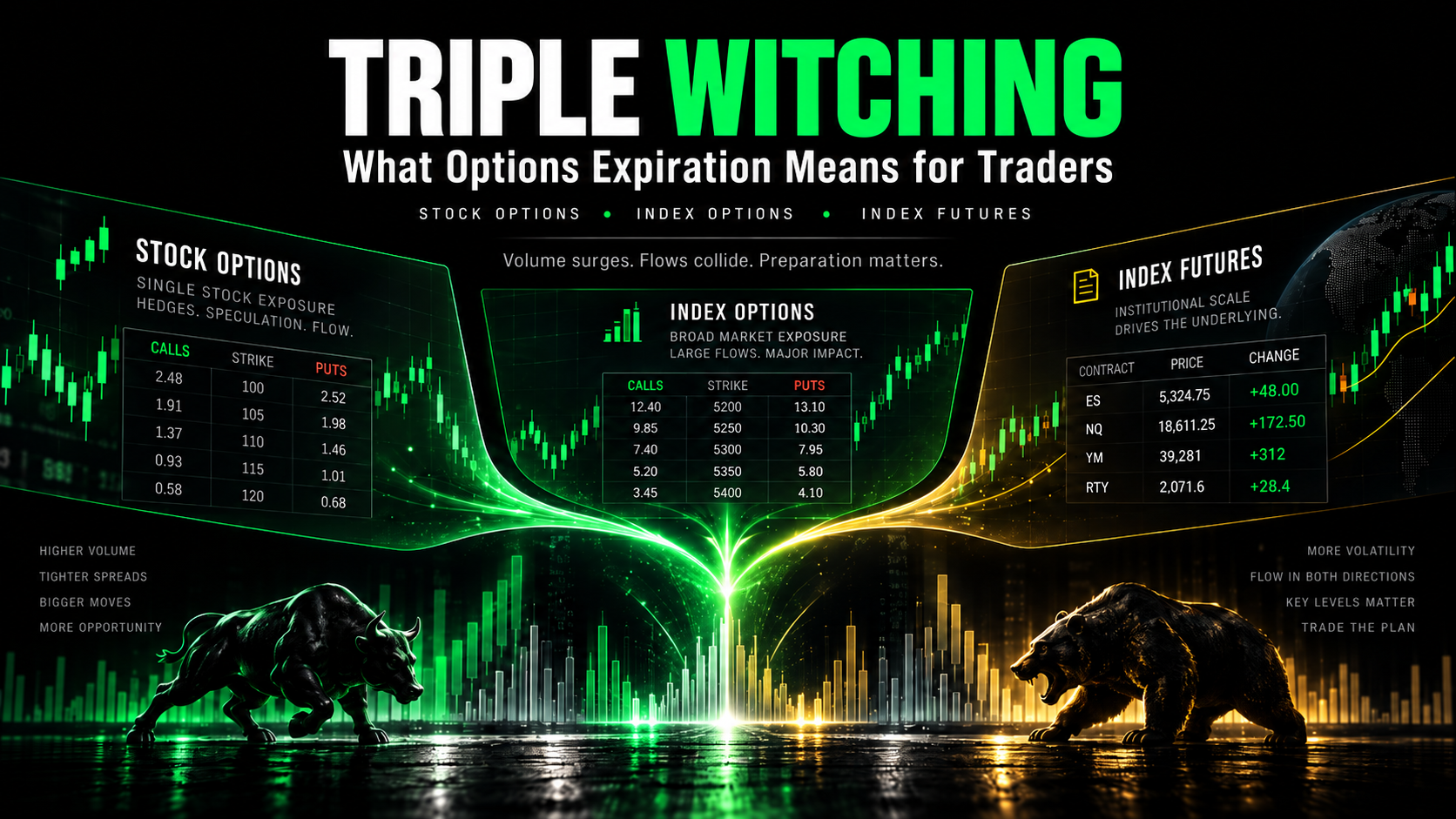
Triple witching is the simultaneous expiration of three major categories of equity derivatives: single-stock options, stock-index options and stock-index futures. The event occurs quarterly, usually on the third Friday of March, June, September and December.
Standard monthly US equity options expire on the third Friday of the expiration month, according to OCC specifications. CME equity-index futures also follow a quarterly March, June, September and December cycle, which causes those calendars to converge four times per year.
The upcoming event occurs on:
Friday, September 18, 2026
The following triple witching session is scheduled for December 18, 2026. In June 2026, the normal third-Friday expiration was shifted to Thursday, June 18 because Juneteenth fell on Friday, June 19 and US markets were closed.
| 2026 Triple Witching | Date |
|---|---|
| March | March 20 |
| June | June 18 |
| September | September 18 |
| December | December 18 |
Triple witching therefore happens four times each year. Monthly options expiration happens much more frequently, but the quarterly events bring several major derivatives cycles together.
Why Is It Called Triple Witching?
The name sounds more dramatic than the mechanics behind it. The term became popular because traders historically associated the simultaneous expiration of several derivative markets with strange price movements, unusually heavy trading and sudden volatility.
The final trading hour became known as the witching hour because large portfolios could be unwound at approximately the same time. Index arbitrage, futures settlement and options hedging could produce enormous bursts of stock-market activity that were difficult to distinguish from genuine buying or selling.
The effect became significant enough that exchanges changed the structure of expiration.
In June 1987, major US exchanges moved settlement for important stock-index futures and options away from the closing price and toward an opening settlement process. Research by Hans Stoll and Robert Whaley later found that quarterly expiration-day trading activity and volatility near the close became smaller after the change.
That history is important because today's triple witching is not exactly the same event traders experienced during the 1980s.
Triple Witching vs. Quadruple Witching
You may also hear the term quadruple witching.
That name became popular when single-stock futures represented a fourth derivative category expiring alongside the other three. For years, financial media used triple witching and quadruple witching almost interchangeably.
The US single-stock futures market effectively disappeared in 2020. The CFTC notes that OneChicago, the only US exchange listing security futures at the time, discontinued trading operations in September 2020, leaving no security futures contracts listed on US exchanges.
For the modern US market, triple witching is therefore the cleaner description.
Why Does Triple Witching Create So Much Trading Volume?
A derivative contract cannot remain open forever. As expiration approaches, the trader holding that contract eventually has to close it, exercise it, allow it to expire or move the exposure into a later expiration.
Now multiply that decision across hedge funds, pension funds, banks, market makers, ETFs, asset managers and millions of retail accounts.
That is where the volume comes from.
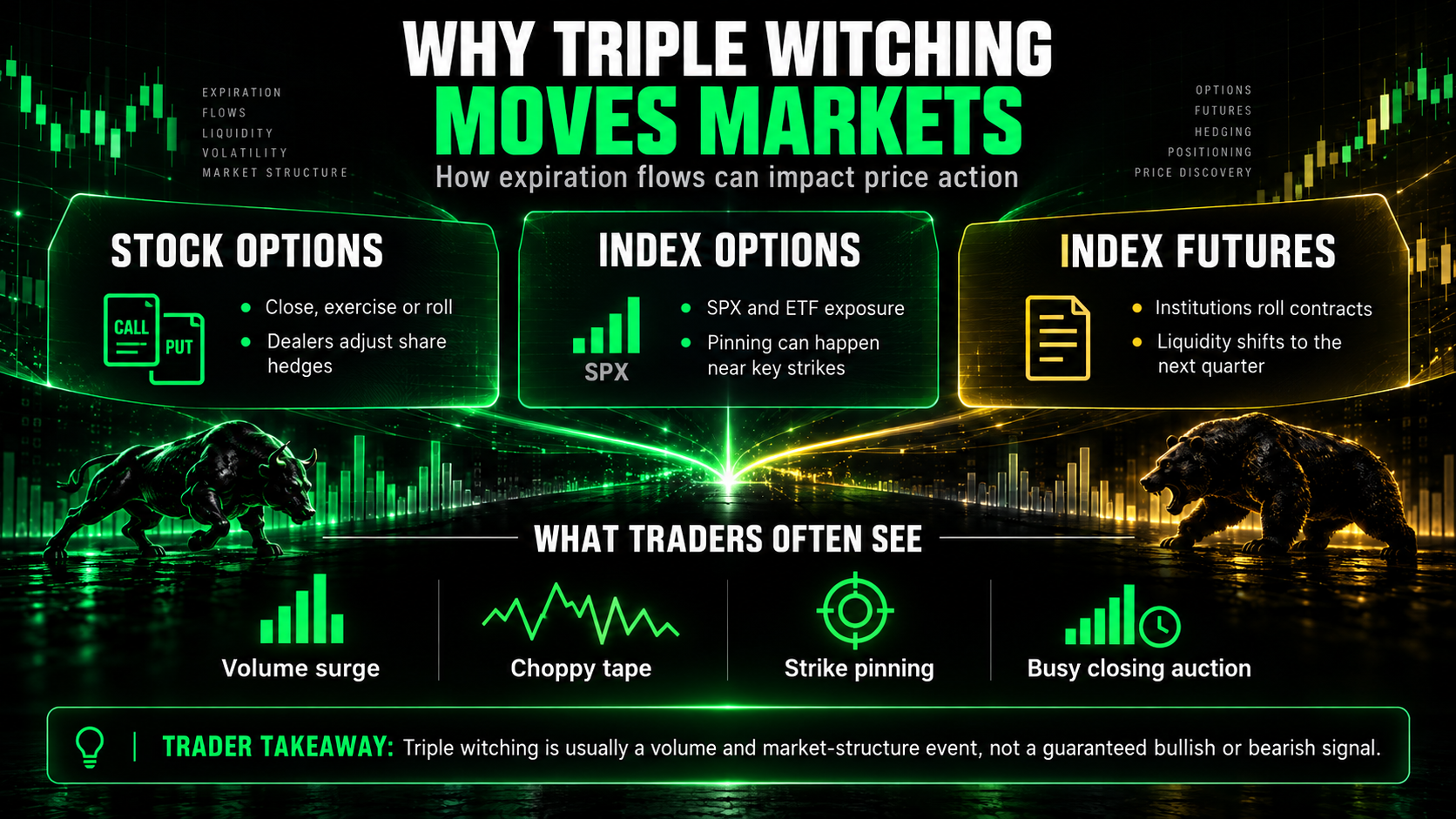
Stock Options
A trader holding September calls or puts may close the position, exercise it, allow it to expire or roll into October, November or another expiration. Market makers on the opposite side may simultaneously need to adjust stock positions used to hedge those options.
Index Options
Large institutions use SPX and other index options to hedge billions of dollars of portfolio exposure. Cboe reported 24.53 million contracts of total SPX options open interest as of September 10, although only a portion of that total belongs to the September 18 expiration.
Index Futures
Asset managers and traders using September futures frequently roll their positions into December rather than allowing the September contract to expire. CME sets the customary US equity-index futures roll date for Monday, September 14, 2026, four days before expiration.
This is why triple witching is not really a one-day event. The mechanical repositioning can begin several sessions beforehand.
The Futures Roll Starts Before Triple Witching Friday
Futures traders need to pay particular attention next week.
CME's customary roll date for September 2026 US equity-index futures is Monday, September 14. After the roll date, CME notes that traders typically begin treating the next quarterly contract as the lead month because liquidity shifts away from the contract approaching expiration.
For an E-mini S&P 500 trader, that means volume should increasingly migrate from the September contract into the December contract.
This matters even if you never hold a futures position overnight. A trader using old futures levels without realizing that liquidity has migrated to a new contract can end up comparing different prices, volume profiles and VWAP calculations.
Chart configuration matters during roll week.
How Futures Actually Settle
Quarterly US equity-index futures use a Special Opening Quotation, usually called the SOQ, for final settlement. CME calculates that settlement from the opening price of every constituent in the underlying index.
That value is not necessarily identical to the S&P 500 price you see at exactly 9:30 AM. Some stocks may not open immediately, and CME notes that approximately 95% of S&P components typically open within 15 minutes and about 98% within 30 minutes.
This creates an important practical distinction between opening expiration flows and the activity traders may see near Friday's closing auction.
Why Options Can Push Stocks Toward Certain Prices
Options positioning can affect the underlying market because market makers frequently hedge their exposure.
Suppose a market maker sells a large number of calls. As the underlying stock changes price, the option's sensitivity to that stock, known as delta, changes as well.
The market maker may need to buy or sell shares or futures to remain hedged.
As expiration gets closer, another option sensitivity called gamma becomes particularly important. Near-the-money options can experience rapid changes in delta when little time remains until expiration, which can force more frequent hedging.
This can create very different market behavior depending on positioning.
What Is Gamma Pinning?
Imagine that enormous open interest sits at the $100 strike while a stock trades around $99.50 on expiration day. If dealer hedging flows continually oppose moves away from the strike, price can appear unusually attracted to the $100 area.
Traders often call this pinning.
A similar effect can occur in major indexes around large SPX option strikes. Price may repeatedly trade around one level even though overall market volume looks enormous.
This does not mean the strike has magical power.
The behavior results from hedging, positioning, liquidity and the rapidly changing probability that options finish in or out of the money.
Positive Gamma and Negative Gamma Can Behave Differently
If dealers are effectively long gamma, their hedging activity can sometimes dampen volatility. They may sell some exposure as markets rise and buy exposure as markets fall.
That can create mean-reverting price action.
If dealers are effectively short gamma, the opposite dynamic can occur. Hedging may require buying as markets rise and selling as markets decline, potentially amplifying momentum.
The important warning is that open interest alone does not tell you dealer positioning with certainty. A trader looking at a giant option strike still needs price confirmation instead of assuming the market must move toward or away from it.
Why Triple Witching Is Different in the 0DTE Era
Modern options markets look very different from the markets that created the triple-witching nickname.
Cboe now lists SPX-related expirations across multiple days of the week, and short-dated options have become a major part of daily market activity. The market therefore experiences options-related gamma and hedging effects far more frequently than it did when monthly expiration dominated the calendar.
That makes triple witching less unique from a pure options-expiration perspective.
What still makes the quarterly event important is the combination of monthly options expiration, quarterly index futures expiration, institutional futures rolls, portfolio adjustments and index rebalancing.
September 18 has all of those ingredients.
Why September 18, 2026 Could Be Especially Important
The upcoming triple witching arrives during an unusually crowded macro week.
The S&P 500 finished Friday, September 11 at 7,656.98, gaining 0.86% on the session. The Nasdaq rose 0.96%, the Dow gained 0.98% and the VIX closed around 15.88, even as markets priced nearly a 90% probability of a Fed rate increase following firm inflation data.
Oil also remains a major complication. Brent spent part of last week above $100 per barrel and finished the week roughly 9% higher, keeping inflation risk front and center for global central banks.
Triple witching will therefore arrive after several events capable of materially changing positioning.
| Date | Market Event | Why It Matters |
|---|---|---|
| Sept. 14 | CME futures roll date | Liquidity begins migrating from September to December futures |
| Sept. 15-16 | Federal Reserve meeting | Markets expect a possible 25 bp rate hike |
| Sept. 16, 2 PM ET | FOMC decision | Could reshape yields, equities and option positioning |
| Sept. 17-18 | Bank of Japan meeting | BOJ expected to raise rates to 1.25% |
| Sept. 18 | Triple witching | Quarterly derivatives expiration |
| Sept. 18 close | S&P rebalance positioning | Passive funds prepare for Sept. 21 index changes |
| Sept. 21 open | S&P index changes effective | New constituents officially enter indexes |
The Federal Reserve has officially scheduled its two-day meeting for September 15 and 16. Reuters also reports that the BOJ is expected to raise its policy rate by 25 basis points to 1.25% on September 18, which would be the highest level in more than three decades.
This creates a very unusual sequence.
The market may spend Wednesday repricing the Fed, Thursday digesting the reaction and Friday dealing with the BOJ, derivatives expiration and index flows simultaneously.
The S&P Rebalance Adds Another Layer
Triple witching is not the only reason September 18 could produce heavy closing volume.
S&P Dow Jones Indices has announced quarterly changes effective before the market opens Monday, September 21. That makes the preceding Friday close a critical implementation point for passive funds and other portfolios tracking those indexes.
The S&P 500 changes include:
| Entering S&P 500 | Leaving S&P 500 |
|---|---|
| Bloom Energy ($BE) | Molson Coors ($TAP) |
| Everpure ($P) | The Trade Desk ($TTD) |
| Illumina ($ILMN) | Builders FirstSource ($BLDR) |
S&P is also making meaningful changes to the S&P 100. Dell $DELL, Palo Alto Networks $PANW, Arista Networks $ANET and Sandisk $SNDK are being added, while Honeywell Aerospace $HONA, Nike $NKE, Simon Property Group $SPG and Colgate-Palmolive $CL are leaving.
These changes can create mechanical demand or supply unrelated to a company's fundamental outlook.
That distinction is extremely important for traders.
A huge volume candle at 3:59 PM does not necessarily mean thousands of investors suddenly changed their opinion about the company.
Does Triple Witching Make the Market Go Down?
No.
Triple witching is not inherently bullish or bearish, and recent history makes that clear. The event consistently affects volume, but the market has produced rallies, selloffs and nearly flat sessions on witching days.
This is one of the most important misconceptions to remove.
If someone tells you triple witching means stocks are about to crash, history does not support that conclusion.
What Happened During Recent Triple Witching Sessions?
Recent sessions provide a useful sample because they occurred under very different macro conditions.
| Triple Witching | S&P 500 | Nasdaq | Trading Volume / Context |
|---|---|---|---|
| Mar. 15, 2024 | -0.65% | -0.96% | 18.76B shares vs. 12.4B 20-day avg |
| Jun. 21, 2024 | -0.16% | -0.18% | Nearly 18B shares, more than 55% above 3-month avg |
| Sept. 20, 2024 | -0.19% | -0.36% | Heavy volume after Fed's 50 bp cut |
| Dec. 20, 2024 | +1.45% | +1.48% | 21.58B vs. 14.87B 20-day avg |
| Mar. 21, 2025 | +0.08% | +0.52% | 21.05B vs. 16.47B 20-day avg |
| Sept. 19, 2025 | +0.49% | +0.72% | 27.78B vs. 17.41B 20-day avg |
| Dec. 19, 2025 | +0.88% | +1.31% | 24.60B vs. 17.19B 20-day avg |
| Mar. 20, 2026 | -0.71% | -0.99% | Iran conflict and rate concerns dominated |
| Jun. 18, 2026 | +1.08% | +1.91% | Holiday-shifted witching session |
The March 2024 session traded 18.76 billion shares, roughly 51% above the preceding 20-session average of about 12.4 billion. The S&P 500 nevertheless fell 0.65%, showing that extraordinary volume did not create a bullish outcome.
June 2024 produced a much smaller 0.16% S&P decline, but nearly 18 billion shares changed hands, more than 55% above the three-month average. Again, the striking feature was volume rather than market direction.
December 2024 went the other way. The S&P rallied 1.45%, and 21.58 billion shares traded compared with a 14.87 billion 20-session average, approximately 45% more activity than normal.
September 2025 provides an even clearer example. The S&P gained 0.49%, the Nasdaq rose 0.72%, and US exchange volume reached 27.78 billion shares compared with a 17.41 billion 20-day average, roughly 60% higher.
The takeaway is straightforward: volume has been far more consistent than direction.
The Historical Lesson From Triple Witching
Triple witching has been creating unusual trading behavior for decades, but the market has evolved to reduce some of its most disruptive effects.
Academic research into expiration-day behavior found that changing stock-index settlement procedures in 1987 reduced abnormal closing activity and volatility associated with quarterly expirations. Modern electronic markets, closing auctions, deeper derivatives liquidity and more frequent options expirations have further changed the structure.
That means traders should be careful using historical witching statistics without understanding how market structure has changed.
The useful pattern that has survived is not "witching Friday goes down."
It is that portfolio mechanics matter more than usual.
Why Volume Can Be Misleading on Triple Witching Day
Most traders are taught that increasing volume confirms a move.
That principle becomes less reliable on triple witching.
Suppose $SPY breaks resistance at 3:50 PM while trading volume explodes. On a normal session, that combination might suggest institutional demand.
On witching Friday, some of that activity may simply reflect option hedges being removed, futures being rolled, index funds rebalancing or closing-auction orders being executed.
The volume is real.
The interpretation may be wrong.
That is why follow-through matters more than the raw volume number.
What Day Traders Should Expect
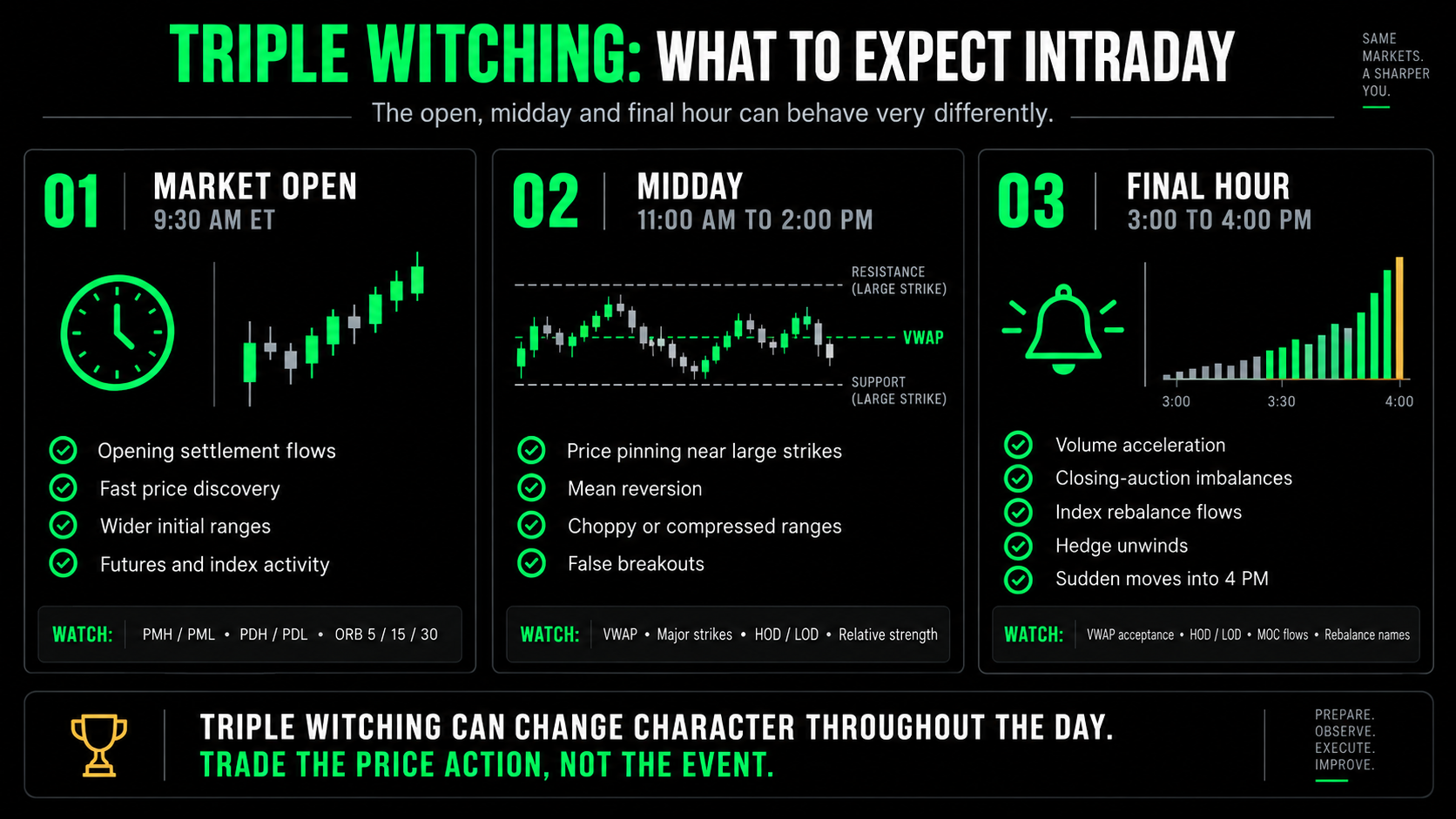
Triple witching can produce several distinct intraday environments rather than one continuous period of volatility.
The opening can be influenced by index settlement activity, the middle of the day may become unexpectedly quiet or pinned, and the final hour can experience another surge as equity options, institutional portfolios and index-rebalance orders converge.
A day trader should therefore treat different parts of Friday as separate environments.
The Opening: Do Not Confuse Noise With Direction
The first 15 to 30 minutes can contain genuine price discovery mixed with settlement-related flows.
This is an environment where ORB 5-minute, 15-minute and 30-minute levels become useful because they force traders to wait for structure rather than react to the first candle. Premarket high, premarket low, prior-day high, prior-day low and VWAP can provide additional confirmation.
If a stock gaps through resistance and immediately loses VWAP, the expiration-day story should not convince you to ignore the chart.
Price still gets the final vote.
Midday: Watch for Pinning
A stock or index that repeatedly returns to the same price despite strong market volume may be experiencing strike-related positioning.
This is where traders should examine large option strikes near the current price, but only as context. A major strike combined with repeated rejection, declining momentum and VWAP interaction is much more useful than an options strike by itself.
Midday pinning can also produce frustrating false breakouts.
Reducing trade frequency is often more intelligent than trying to force a trend into a market that is temporarily mean reverting.
The Final Hour: Expect the Tape to Change
The closing hour deserves particular attention on September 18 because expiration is coinciding with S&P quarterly index changes.
Large market-on-close and closing-auction orders can create abrupt moves in individual names. Stocks entering or leaving major indexes deserve particular attention because passive managers need to adjust their holdings to track the revised benchmark.
That can produce extraordinary volume without creating a tradable trend after the close.
A stock can surge into 4 PM and then behave completely differently Monday morning once the mechanical buyer disappears.
How I Would Day Trade Triple Witching
The goal should not be to invent a special "triple witching strategy." The better approach is to adjust normal trading rules for an environment where market mechanics can distort otherwise familiar signals.
| Trading Area | Witching-Day Adjustment |
|---|---|
| Position size | Reduce dollar risk if price action becomes unusually erratic |
| Opening trades | Let the opening range develop before assuming direction |
| VWAP | Require cleaner acceptance or rejection around VWAP |
| Breakouts | Demand price confirmation, not volume alone |
| Relative volume | Separate true catalyst volume from market-wide expiry volume |
| Stops | Use technical invalidation, then size the position to match risk |
| Index names | Watch SPY, QQQ, IWM and major index constituents closely |
| Options | Know exactly when the contract expires and how it settles |
| Final hour | Expect auction and rebalance flows to distort individual stocks |
| After-hours analysis | Do not assume Friday's closing move will continue Monday |
One adjustment is particularly important: do not automatically widen your stop because the market is volatile. A better solution is often to reduce share size while keeping the stop where the trade thesis is actually invalidated.
That keeps dollar risk controlled without giving a poor setup more room simply because it happens to be witching Friday.
How VWAP Can Help During Triple Witching
VWAP becomes especially useful when raw volume loses some of its informational value.
If an index is experiencing huge expiration-related turnover but continues holding above a rising VWAP, the market may still be accepting higher prices despite the mechanical flows. If price repeatedly breaks above major strikes but cannot hold above VWAP, the breakout may deserve more skepticism.
VWAP should still be combined with structure.
For ChartClub traders, that means watching VWAP, HOD, LOD, ORB levels, PMH, PML, PDH and PDL together rather than treating any single indicator as the trade.
How Swing Traders Should Handle Triple Witching
Swing traders face a different problem.
The danger is less about five-minute volatility and more about interpreting Friday's closing price as information that may not actually be there.
A breakout occurring at 3:55 PM on enormous rebalance volume may look exceptional on a daily chart. If the buying was primarily mechanical, however, Monday's market may not contain the same demand.
That does not mean every Friday breakout should be avoided.
It means Monday confirmation becomes more valuable.
Watch Monday's Follow-Through
Suppose a stock closes 3% above a major resistance level on witching Friday with triple its normal volume.
Instead of automatically interpreting that as institutional accumulation, examine what happens Monday. If the stock holds above the breakout level, builds volume and continues attracting buyers after the mechanical event has cleared, the signal becomes more meaningful.
If it immediately falls back below resistance, Friday may have been primarily flow driven.
This principle is particularly important for the September 18 closing auction because the S&P quarterly rebalance takes effect before the September 21 open.
Swing Traders Using Options Need an Extra Checklist
Options traders cannot ignore expiration mechanics.
A stock trader can generally decide to hold a position for another day. An expiring options contract does not provide that flexibility.
Before Friday, know the contract's expiration, whether it is in or out of the money, whether exercise or assignment is possible, how your broker handles expiration and whether you intend to roll the position.
For index products, also understand whether the contract is AM-settled or PM-settled.
Standard monthly SPX-related contracts can use opening settlement mechanics that differ substantially from an ETF option such as $SPY. That distinction can surprise traders who assume every Friday option is settled against the 4 PM closing price.
What Long-Term Investors Should Do
For a long-term investor, triple witching is usually more interesting than dangerous.
A temporary surge in volume or an unusual closing auction rarely changes a company's earnings power, competitive position or long-term valuation. Investors should therefore be careful about making portfolio decisions based solely on expiration-day volatility.
The event can still create opportunities.
Mechanical flows can occasionally push individual securities away from prices justified by their underlying fundamentals, particularly around index additions and deletions. Long-term investors can use those periods to update watchlists and valuations without feeling compelled to trade every move.
Stocks to Watch Around September 18
The broad market should be watched through $SPY, $QQQ and $IWM, while the futures market should be monitored through the active S&P 500, Nasdaq-100 and Russell contracts.
The upcoming S&P rebalance creates additional reasons to watch $BE, $P, $ILMN, $TAP, $TTD and $BLDR. The S&P 100 changes also put $DELL, $PANW, $ANET, $SNDK, $HONA, $NKE, $SPG and $CL in the spotlight.
These names could experience closing volume significantly above their normal baselines.
That does not automatically make them long or short setups.
The opportunity comes from understanding why the abnormal flow exists.
The Most Important Levels to Mark Before Friday
A prepared trader should enter Friday with a map already built.
For the major indexes and each stock on the watchlist, identify the previous day's high and low, premarket high and low, weekly high and low, VWAP, major daily support and resistance, important option strikes, and the opening range after the market begins trading.
It is also worth checking where price sits relative to major round numbers.
A market trading at 7,598 near a massive 7,600 SPX strike can behave differently from one trading 100 points away from concentrated option interest.
The options information should complement the chart.
It should not replace it.
Do Not Blindly Trade "Max Pain"
Options communities frequently discuss a concept called max pain, which estimates the expiration price that would cause the largest aggregate loss to option holders.
It can be interesting context, but it should not be treated as a price target.
Open interest does not reveal every participant's complete hedge, whether the option was bought or sold, whether another derivative offsets the position or how market makers are positioned.
Markets also respond to new information.
A Fed surprise, BOJ surprise, geopolitical escalation or major corporate news can overwhelm an options-derived level immediately.
Use derivatives positioning to understand possible flows, not to predict the future with false precision.
What Could Make September 18 More Volatile Than Normal?
Several factors could increase volatility beyond the mechanical expiration itself.
The first is Wednesday's Federal Reserve decision. Markets entered the weekend assigning a high probability to another rate increase, which means any surprise in the decision or Chair Kevin Warsh's guidance could cause a substantial repricing across stocks, bonds and the dollar.
The second is Japan.
The BOJ is expected to raise rates to 1.25%, while speculative positioning in the yen has just turned net long for the first time since February. Yen carry trades matter globally because investors have historically borrowed cheaply in yen to fund investments elsewhere, meaning a disorderly unwind can affect assets far outside Japan.
The third is energy.
Brent recently moved back above $100 amid continuing Middle East instability. Another oil shock could alter Fed expectations, bond yields and equity positioning days before expiration.
The fourth is the index rebalance.
That gives September 18 a potentially significant closing-flow catalyst even if the broader market remains calm.
What Could Make Triple Witching Surprisingly Quiet?
A large expiration does not guarantee large index moves.
If the Fed decision is close to expectations, the BOJ avoids surprising markets and dealer positioning remains stabilizing, the S&P 500 could trade in a relatively narrow range despite enormous turnover.
That outcome would actually be consistent with triple witching history.
High volume and low net movement can coexist because buyers and sellers may simply be transferring, hedging and rolling positions rather than expressing new directional views.
The tape can be extremely busy while the index goes almost nowhere.
A Triple Witching Preparation Plan
Preparation should begin before Friday because September futures begin their customary roll on Monday.
| When | What to Prepare |
|---|---|
| Sunday | Build broad market and rebalance watchlists |
| Monday, Sept. 14 | Confirm the active futures contract as the roll begins |
| Tuesday | Update SPX, SPY, QQQ and IWM option-interest levels |
| Wednesday | Re-map everything after the Fed decision |
| Thursday | Review BOJ risk, closing-auction candidates and Friday levels |
| Friday premarket | Mark PMH/PML, PDH/PDL, major strikes and VWAP plan |
| Friday open | Let opening settlement and early volatility develop |
| Friday afternoon | Watch HOD/LOD, VWAP, options pinning and breadth |
| Final hour | Expect abnormal volume and rebalance flows |
| Monday, Sept. 21 | Judge which Friday moves actually held |
This process prevents one of the most common mistakes traders make around special market events: changing strategy because they suddenly discover the event after the market has already started moving.
What Triple Witching Does Not Tell You
Triple witching tells you that a large amount of market positioning is reaching an important transition point.
It does not tell you whether the S&P 500 will finish green or red.
It does not tell you whether $NVDA will break out, whether Bitcoin will rally or whether the market will reverse at 2 PM.
History shows positive and negative witching sessions.
What the event provides is context.
That context helps explain why volume may be enormous, why a stock may become pinned near a strike, why futures liquidity is migrating and why the closing auction may behave differently from an ordinary Friday.
Triple Witching FAQ
When Is the Next Triple Witching Day?
The next US triple witching session is Friday, September 18, 2026. It brings quarterly stock-index futures expiration together with standard monthly stock and index options expiration.
The next event after September will occur on December 18, 2026. Triple witching normally occurs on the third Friday of March, June, September and December.
How Often Does Triple Witching Happen?
Triple witching occurs four times per year. The standard schedule is March, June, September and December.
If the third Friday is an exchange holiday, the practical expiration session moves to the preceding trading day. June 2026 was an example because Juneteenth shifted the event to Thursday, June 18.
Does Triple Witching Cause the Market to Crash?
No. Recent triple witching sessions have included meaningful rallies, declines and nearly flat closes.
The more repeatable feature is elevated trading activity. For example, September 2025 produced approximately 27.78 billion shares of US exchange volume, roughly 60% above the preceding 20-session average, while the S&P 500 actually gained 0.49%.
Why Does Volume Increase on Triple Witching?
Options and futures positions must be closed, exercised, settled or rolled into later expirations. Market makers can also adjust hedges as option deltas change rapidly near expiration.
Quarterly index rebalancing and portfolio adjustments can add even more activity. September 2026 includes both derivative expiration and significant S&P index changes.
What Time Is Triple Witching Most Volatile?
The open and final hour often deserve the most attention, but modern settlement rules mean there is no single universal witching hour. Some index derivatives use opening settlement, while single-stock and ETF activity can remain important through the closing auction.
The final hour can become especially active when index rebalances coincide with expiration. September 18 has that added feature.
Can Triple Witching Cause Stocks to Become Pinned?
Yes, large option positioning around nearby strikes can sometimes contribute to price pinning. Dealer hedging can create mean-reverting behavior when certain positioning conditions are present.
A large strike is not enough by itself to justify a trade. Traders should combine options positioning with price structure, VWAP, volume, momentum and broader market direction.
Is Triple Witching Good for Day Trading?
It can create opportunity because liquidity and activity are often elevated, but it can also create false breakouts and price action driven by mechanical flows. The key is recognizing that high volume does not automatically mean strong directional conviction.
Day traders may benefit from waiting for an opening range, tracking VWAP and reducing position size when the tape becomes unusually erratic.
Should Swing Traders Avoid Triple Witching?
Not necessarily. Swing traders should simply be more cautious about interpreting Friday's closing price and volume.
Moves that remain intact after Monday's open provide stronger evidence that genuine demand or supply existed beyond expiration and rebalance mechanics.
The ChartClub Takeaway
Triple witching is a perfect example of why understanding market structure matters.
A trader looking only at a candlestick might see massive volume and assume institutional accumulation. Another trader who understands derivatives expiration, futures rolls, dealer hedging and index rebalancing may realize that the same candle contains a large amount of mechanical activity.
That difference changes how the trade is interpreted.
At ChartClub, the goal is not to predict that September 18 will be green, red or chaotic. The goal is to prepare traders with enough context to recognize what kind of market they are trading when the session begins.
For day traders, that means combining VWAP, ORB 5/15/30, PMH/PML, PDH/PDL, HOD/LOD, relative volume and real-time market intelligence with an understanding of the expiration calendar.
For swing traders and investors, it means knowing when unusual volume might be temporary and waiting for genuine follow-through before treating a mechanically driven move as a change in trend.
The edge is not knowing that triple witching exists.
The edge is understanding why the market is moving, what is causing the volume and whether the move survives once the mechanical flows disappear.
Trade. Swing. Invest.
Visit ChartClub.io for market education, market intelligence, trading tools and a community focused on discipline, process and better decision-making.
This article is for educational and informational purposes only. It is not financial advice, investment advice or a recommendation to buy or sell any security, option, futures contract or other financial instrument. Options and futures involve substantial risk and are not appropriate for every investor or trader.
Sources and Further Reading
| Source | Link |
|---|---|
| Cboe | 2026 US options expiration schedule. Cboe 2026 Options Expiration Calendar |
| OCC | Standard US equity-option expiration specifications. OCC Equity Options Specifications |
| CME Group | September 2026 futures expiration and roll schedule. CME Equity Index Roll Dates |
| CME Group | Special Opening Quotation and quarterly futures settlement mechanics. CME Final Settlement Procedures |
| CFTC | History of US single-stock futures and OneChicago's closure. CFTC Security Futures Record |
| CFA Institute | Academic research into historical expiration-day effects. Expiration-Day Effects: What Has Changed? |
| Federal Reserve | September 15-16 FOMC calendar. Federal Reserve September 2026 Calendar |
| S&P Dow Jones Indices | September 2026 S&P 500, S&P 100, MidCap and SmallCap changes. September 2026 S&P Index Rebalance |
| Reuters | Current Fed, BOJ, oil and global-market setup heading into the week. Rates, Risks and Rivalries |
| Reuters | September 11 US market close and current Fed expectations. Wall Street After August CPI |
| Reuters | March 2024 triple witching market reaction. March 2024 Triple Witching Session |
| Reuters | March 2025 expiration-day price action and volume. March 2025 Triple Witching Session |
| Reuters | September 2025 record-volume witching session. September 2025 Triple Witching Session |
| Reuters | December 2025 triple witching rally and volume. December 2025 Triple Witching Session |