Why Are Stocks Falling Today? The Global Bond Rout Is Sending Yields Toward 5%
A global government bond selloff is pushing borrowing costs to multi-decade highs. Here is why yields are rising, why stocks and AI names are under pressure, and what traders should watch next.
Why Are Stocks Falling Today? The Global Bond Rout Is Sending Yields Toward 5%
Stocks are falling today, but the real story is happening somewhere many equity traders do not watch nearly enough:
The bond market.
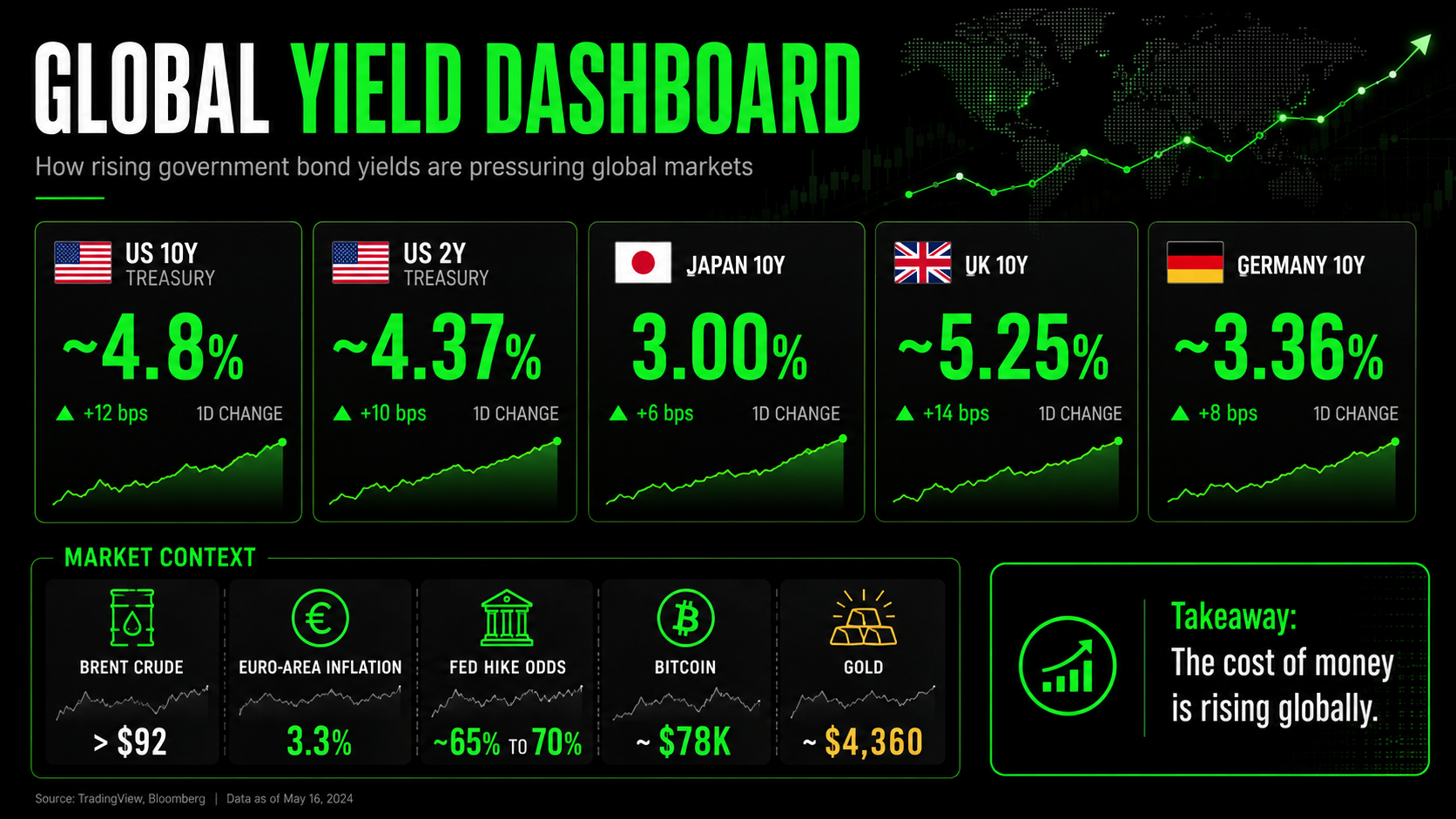
Government borrowing costs are rising across the United States, Japan, Germany and the United Kingdom, with several benchmark yields reaching levels not seen in years or even decades.
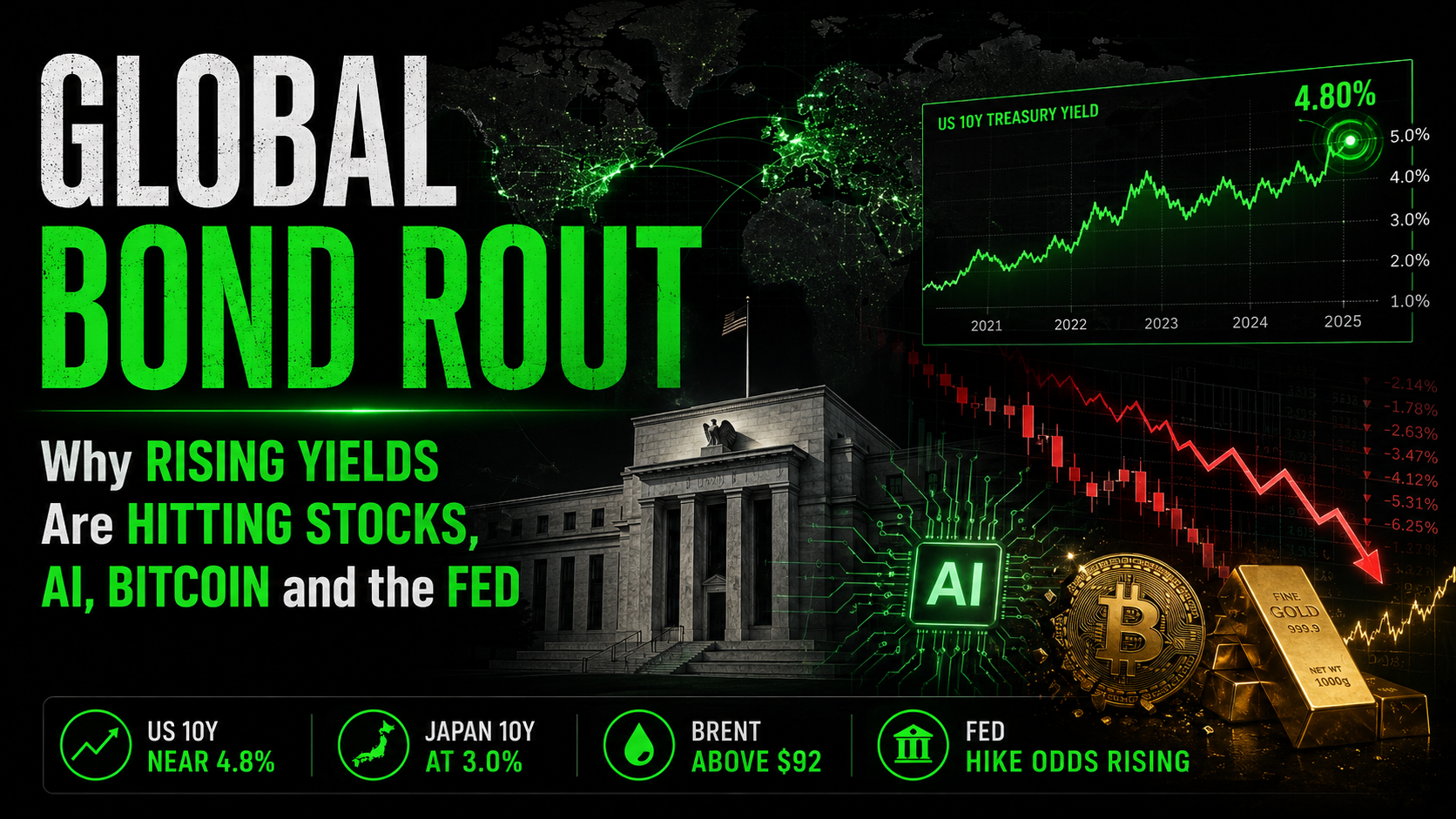
The US 10-year Treasury yield has pushed to roughly 4.8%, its highest level since early 2025.
Japan's 10-year government bond yield touched 3.00% for the first time since 1996.
Britain's 10-year yield moved above 5.25%, its highest since 2008.
Germany's 10-year Bund yield reached roughly 3.36%, its highest level in around 15 years.
At the same time, Brent crude is above $92, euro-area inflation has accelerated to 3.3%, Bitcoin is around $78,000, and markets are assigning an increasingly high probability to another Federal Reserve rate hike in September.
These are not separate stories.
They are increasingly connected.
And if the global bond selloff continues, it could become one of the most important market themes of September.
The Market Snapshot
Here is the setup as September begins:
Market Current Situation US 10-Year Treasury ~4.8% US 2-Year Treasury ~4.37% Japan 10-Year 3.00% UK 10-Year ~5.25% Germany 10-Year ~3.36% Brent Crude >$92/barrel Euro-Area Inflation 3.3% YoY Euro-Area Energy Inflation 14.3% YoY July US PCE Inflation 3.7% YoY September Fed Hike Odds ~65% to 70% Bitcoin ~$78K Gold ~$4,360/oz
The exact market prices will change intraday.
The bigger message matters more:
The cost of money is rising across the world.
Stocks Opened Lower as Bond Yields Surged
Wall Street immediately felt the pressure.
At Tuesday's open:
Index Initial Move Dow -0.19% S&P 500 -0.66% Nasdaq Composite -1.29%
About 15 minutes later, the Nasdaq was down around 1.4%, while the S&P 500 was off roughly 0.7%.
The Nasdaq's larger decline matters.
Technology and growth stocks are generally more sensitive to rising interest rates because a larger portion of their valuation depends on earnings expected further into the future.
Higher yields change what investors are willing to pay for those future earnings.
That is why a bond selloff can turn into an equity selloff even when nothing directly changed overnight about a company's products, customers or revenue.
First, What Is a Bond Yield?
Before going deeper, this is worth understanding.
A bond is essentially a loan.
When you buy a US Treasury bond, you are lending money to the US government. In exchange, you receive interest.
The important relationship is simple:
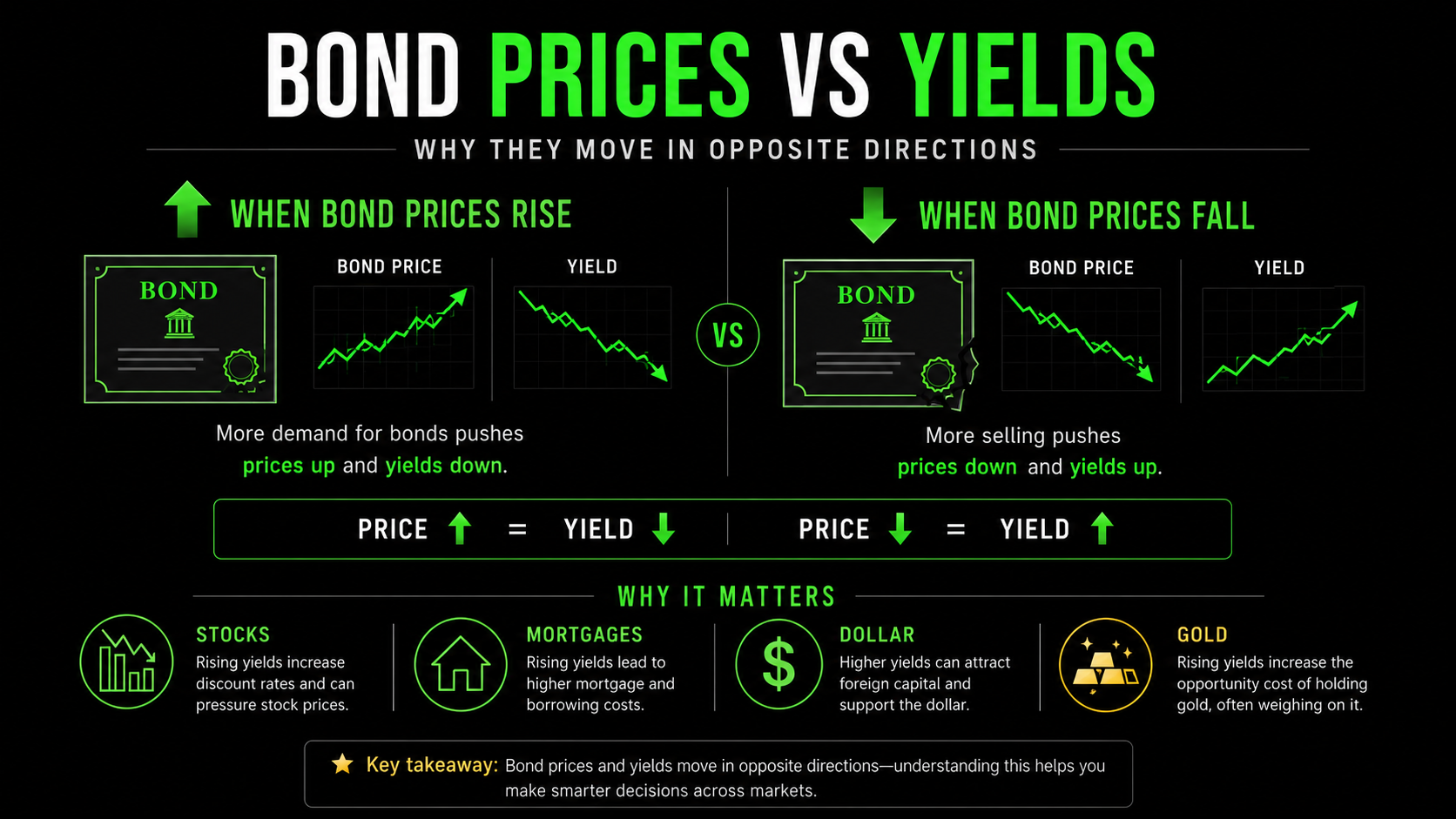
Bond prices and bond yields move in opposite directions.
When investors aggressively sell bonds:
Bond prices fall → Bond yields rise
When investors aggressively buy bonds:
Bond prices rise → Bond yields fall
So when we say there is a bond rout, we mean investors are selling bonds aggressively enough that yields are rising materially.
Today's move is important because it is happening globally.
Why Are Bond Yields Rising?
There is no single reason.
Several powerful forces are hitting the market at the same time.
- Inflation Is Still Too High
Central banks spent years fighting inflation.
That fight is not finished.
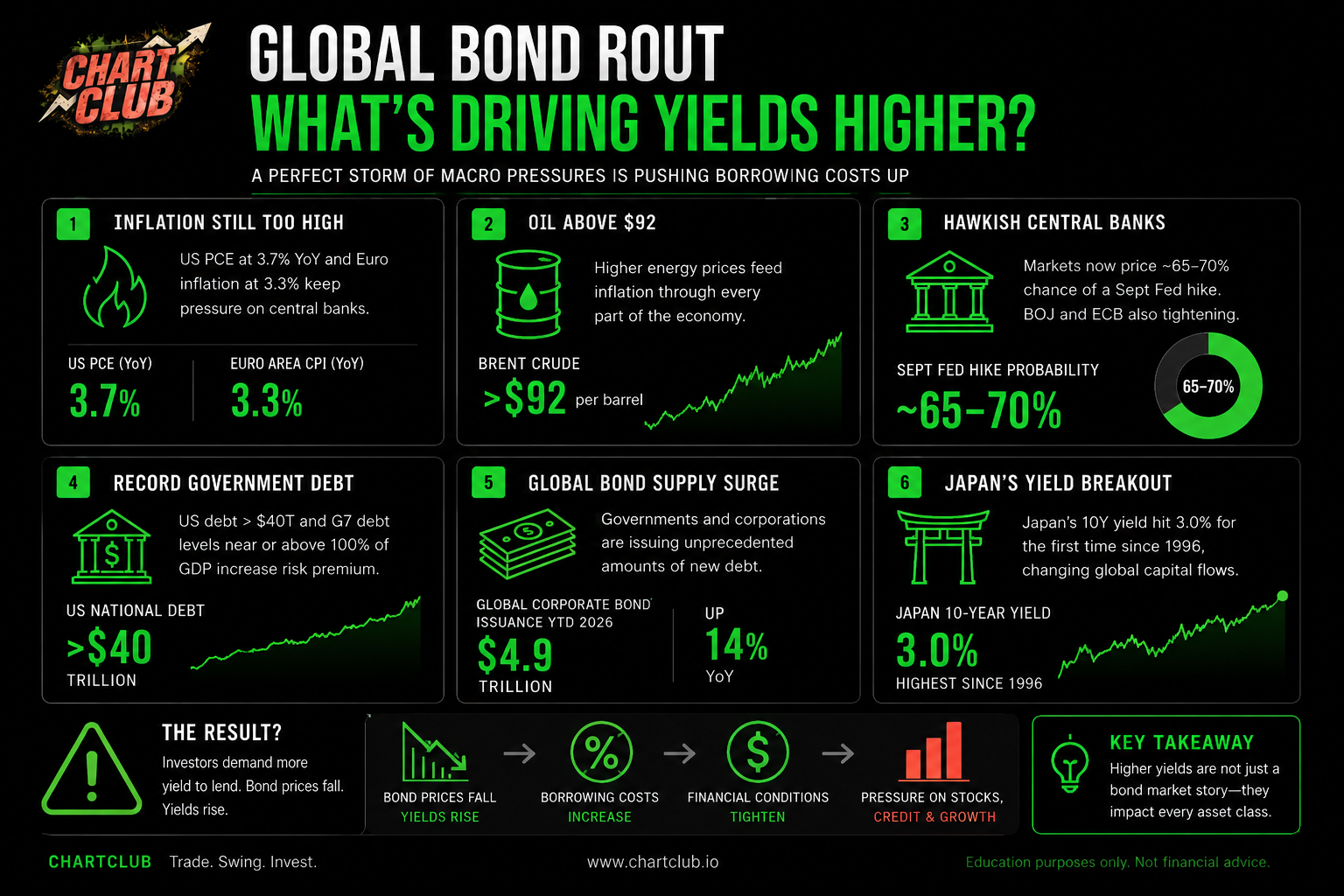
US PCE inflation was 3.7% year over year in July, while core PCE was 3.3%.
The Federal Reserve's target is around 2%.
Then Europe delivered another inflation surprise Tuesday morning.
Eurostat reported August euro-area inflation at 3.3%, up from 2.9% in July.
Energy inflation was even more striking, climbing to 14.3% from 10.3% one month earlier.
That makes bond investors uncomfortable.
If inflation remains elevated, investors generally want more compensation for lending money for 10, 20 or 30 years.
That means higher yields.
- Oil Above $92 Is Making the Inflation Problem Worse
This connects directly to the US-Iran oil story.
Brent crude surged above $92 per barrel as renewed military conflict reduced hopes that shipping conditions in the Strait of Hormuz would normalize soon.
Oil matters because higher energy prices move through the economy.
Oil → Gasoline → Diesel → Transportation → Manufacturing → Consumer Prices → Inflation
If energy remains expensive, central banks may need to keep interest rates higher for longer.
Bond markets understand that.
So oil above $92 is not simply bullish for energy stocks.
It can also be bearish for bonds.
And when bonds sell off hard enough, it can become bearish for stocks too.
- Kevin Warsh Changed the Fed Trade at Jackson Hole
Federal Reserve Chair Kevin Warsh's Jackson Hole speech materially changed interest-rate expectations.
Warsh said policymakers still have "work to do" if they cannot gain confidence that inflation is returning toward the Fed's 2% target.
Markets took the message seriously.
A week ago, futures markets priced roughly a 40% chance of a September rate hike.
By Tuesday morning, that probability had risen to around 65%.
Then came another round of US economic data.
And the probability moved even higher.
Today's JOLTS Report Did Not Give the Fed Much Reason to Panic
At 10:00 a.m. ET Tuesday, the Bureau of Labor Statistics released the July Job Openings and Labor Turnover Survey.
The results showed:
JOLTS Metric July 2026 Job openings 7.3M Hires 5.1M Total separations 5.1M Quits 3.1M Layoffs and discharges 1.7M
The BLS described job openings as little changed. Hiring also remained around 5.1 million, while layoffs stayed relatively contained.
This reinforces an unusual labor-market environment.
Hiring is not particularly strong.
But companies are not aggressively firing people either.
That matters for the Fed because a labor market cooling slowly rather than collapsing gives policymakers more room to focus on inflation.
Then ISM Added More Inflation Pressure
The second 10:00 a.m. report was arguably even more important for bonds.
The Institute for Supply Management's August manufacturing PMI came in at:
54.6
Anything above 50 signals expansion.
Manufacturing therefore remains in growth territory.
But the inflation component stood out.
The ISM prices-paid index remained at:
71.1
That is a very elevated reading.
New orders eased to 53.7, while factory employment came in at 51.2.
The overall message was not:
The economy is collapsing.
It was closer to:
Growth is moderating, but price pressure remains stubborn.
Following the data, markets were pricing roughly a 70% probability of a 25-basis-point September hike.
That is exactly the kind of combination bond investors dislike.
The Fed Already Has Three Officials Who Wanted a Hike
At the July FOMC meeting, the Fed held its target range at:
3.50% to 3.75%
But the decision was not unanimous.
Beth Hammack, Neel Kashkari and Lorie Logan all preferred a 25-basis-point rate increase.
Now add:
3.7% PCE inflation $92 oil stronger European inflation Warsh's hawkish Jackson Hole message elevated ISM prices
The September decision suddenly looks much more live than it did only one week ago.
The next FOMC meeting is scheduled for September 15 to 16, 2026.
Why Japan Hitting 3% Is Such a Big Deal
For years, Japan was the world's low-interest-rate anchor.
That made Japanese government bonds very different from most developed-market bonds.
Now Japan's benchmark 10-year yield has reached:
3%
for the first time since 1996.
Japan's 2-year yield also reached around 1.81%, its highest level in 31 years.
The Bank of Japan is increasingly expected to raise rates again at its September 17 to 18 meeting, with markets nearly fully pricing a move to 1.25% from 1%.
Think about what this means.
Someone who spent most of their investing career thinking:
Japanese rates are basically zero.
now has to think differently.
And this is more than a Japan story.
Japan Can Affect US Treasuries Too
Japanese investors are major participants in global bond markets.
When domestic Japanese bonds yielded very little, investors had a powerful incentive to search overseas for higher returns.
US Treasuries were one destination.
European bonds were another.
But if Japanese government bonds suddenly offer materially higher yields at home, the relative attractiveness of owning foreign debt changes.
That could mean:
less Japanese demand for overseas bonds more capital remaining inside Japan some overseas capital returning home
This is one reason the Japanese 3% milestone matters to someone trading $SPY in New York.
Money is global.
USD/JPY Near 160 Makes the Story Even More Complicated
Japan has another problem.
The yen remains weak.
USD/JPY has been trading around:
160
after reaching nearly 164 before last month's coordinated Japan-US currency intervention.
A weak yen makes imports more expensive for Japan.
That can increase inflation.
Higher inflation can push the Bank of Japan toward higher rates.
Higher Japanese rates can push Japanese bond yields higher.
And higher Japanese yields can affect global capital flows.
The chain keeps getting longer.
Europe Is Joining the Bond Rout Too
This is not simply the Federal Reserve and Bank of Japan tightening at the same time.
Europe is now part of the equation.
Germany's 10-year Bund yield reached approximately 3.36%, its highest level in around 15 years.
Britain's 10-year yield climbed above 5.25%, its highest since 2008.
Meanwhile, euro-area inflation rising to 3.3% has increased expectations for another European Central Bank rate hike.
So September could potentially bring monetary tightening from:
Federal Reserve European Central Bank Bank of Japan
all within the same general period.
That is not a friendly backdrop for long-duration bonds.
There Is Another Problem: Governments Are Borrowing a Lot of Money
Inflation is not the only reason yields are rising.
Supply matters too.
US public debt has now crossed:
$40 trillion
Debt-to-GDP is at or above 100% across nearly every G7 economy except Germany.
Governments need to finance that debt.
How?
By selling bonds.
More government borrowing means more bond supply.
If investors are asked to absorb more bonds while inflation remains elevated, they may demand higher yields as compensation.
That is basic supply and demand.
This Is Where "Bond Vigilantes" Enter the Conversation
You may hear the phrase bond vigilantes more often if yields continue rising.
It describes investors effectively imposing discipline on governments by demanding higher interest rates when they become uncomfortable with:
government spending fiscal deficits debt inflation fiscal credibility
Many strategists still view the current rise in yields as an orderly repricing rather than a market crisis.
But the message from bond markets is becoming harder for governments to ignore.
If investors lose confidence in fiscal discipline, they do not need to organize a protest.
They simply demand a higher yield.
The US 30-Year Has Already Flashed a Warning
Earlier in August, the US 30-year Treasury yield reached approximately:
5.34%
That was roughly a 19-year high.
It subsequently fell after the Treasury announced expanded buybacks of long-dated bonds, but long-term borrowing costs have begun rising again.
That distinction matters.
The Fed has more influence over short-term interest rates.
Long-term yields incorporate much more:
inflation economic growth government debt fiscal credibility bond supply term premium global capital flows
If the Fed cuts or holds rates while 10-year and 30-year yields continue climbing, borrowing conditions can still tighten.
A 4.8% 10-Year Treasury Does Not Stay Inside the Bond Market
The US 10-year Treasury is a benchmark used throughout finance.
As it rises, other borrowing rates tend to move too.
US 30-year mortgage rates have already risen toward:
6.7%
Higher bond yields can eventually mean:
higher mortgage rates higher corporate borrowing costs more expensive auto financing more expensive refinancing higher government interest costs
So when the 10-year moves from 4.3% toward 4.8%, that is not simply a chart for bond traders.
It changes the economy's cost of capital.
Why Higher Yields Hit Stocks
Stocks have to compete with bonds for capital.
Imagine a Treasury bond yields 2%.
An investor may be willing to accept more risk in stocks because safer assets offer relatively little return.
Now imagine Treasury yields approach 5%.
Suddenly, a relatively low-risk government bond offers a much more meaningful return.
Stocks need to justify their additional risk.
The market effectively asks:
Why should I pay an extremely high multiple for uncertain future earnings when I can earn close to 5% from government debt?
That does not mean stocks automatically collapse at 5%.
But the hurdle gets higher.
Why $QQQ Can Be More Sensitive Than $SPY
Technology stocks tend to be particularly sensitive to rates.
A major reason is duration.
Consider a company expected to generate enormous profits 10 years from now.
Investors discount those future cash flows back into today's dollars.
The higher the discount rate, the less those future dollars are worth today.
That is why rising yields can disproportionately affect:
$QQQ, $NVDA, $AVGO, $MSFT, $AMZN, $GOOGL, $META
and other long-duration growth assets.
The Nasdaq's roughly 1.3% to 1.4% decline around Tuesday's open, compared with the smaller S&P 500 decline, fits that pattern.
The AI Boom Has Created a New Bond-Market Problem
This is one of the most interesting parts of the story.
Artificial intelligence companies need enormous amounts of infrastructure:
data centers GPUs networking energy cooling transmission lines land cloud infrastructure
That means capital.
Lots of it.
Five of the biggest AI hyperscalers, Alphabet, Amazon, Meta, Microsoft and Oracle, have already issued approximately:
$220 billion in debt during 2026
That is more than double last year's total.
Global corporate bond issuance has reached approximately:
$4.9 trillion
so far this year, around:
14% higher YoY
The AI boom is increasingly becoming a bond-market story too.
AI-Related Debt Could Approach $570 Billion This Year
Morgan Stanley expects global AI-related debt issuance to reach approximately:
$570 billion in 2026
more than double the previous year.
As of May 31 alone, AI-related debt issuance had already reached around:
$236 billion
roughly four times the amount from the same point in 2025.
The four major hyperscalers highlighted by Morgan Stanley are expected to spend around:
$700 billion this year
And hyperscaler capital expenditure could exceed:
$1 trillion in 2027
That creates an interesting contradiction.
AI spending is helping drive economic growth.
But financing the AI boom can also increase demand for capital.
More borrowing means more bonds.
More bonds can contribute to higher yields.
And higher yields can pressure AI valuations.
The AI boom may partly be increasing the cost of financing the AI boom.
The Fed Is Already Watching AI Financing
Federal Reserve officials have started discussing this.
Some Fed officials are paying closer attention to the amount of borrowing and increasingly complex financing structures supporting AI infrastructure.
New York Fed President John Williams has said he does not currently view AI financing as a bubble-style systemic threat.
Other officials have expressed more concern about potential leverage and interconnected financing between:
data centers energy providers technology companies communities lenders
That does not mean an AI credit crisis is coming.
It means financing conditions matter more than they did when most large technology companies could fund almost everything from internal cash flow.
The Real AI Question May Be Changing
For the last few years, investors have asked:
How fast can AI grow?
The next question may increasingly become:
How expensive can capital get before AI valuations notice?
Nvidia just forecast roughly 70% revenue growth next fiscal year, reinforcing expectations that AI demand remains extraordinary.
So the fundamental AI story has not disappeared.
Instead, two powerful forces are colliding:
AI earnings growth
versus
rising discount rates
If earnings grow fast enough, stocks can absorb higher yields.
If yields keep rising faster than earnings expectations, valuations become harder to defend.
That could become one of the defining equity-market battles of the next several quarters.
Why Small Caps May Have an Even Bigger Problem
Mega-cap technology companies often have enormous cash balances and strong access to capital.
Small businesses do not necessarily have that luxury.
Small-cap companies may rely more heavily on:
bank borrowing floating-rate debt refinancing credit markets economically sensitive revenue
That makes $IWM important.
If the 10-year Treasury approaches 5% while the Fed remains restrictive, smaller companies could feel financial conditions tightening more quickly.
For small-cap investors, the question is not simply:
Are rates high?
It is:
Can these companies refinance profitably at those rates?
Banks and Financials Are More Complicated
Higher interest rates can help banks in some environments.
Banks can earn larger spreads between what they pay depositors and what they earn on loans.
But rapidly rising long-term yields can also create problems:
bond portfolios lose value borrowers become stressed loan demand can weaken credit losses can rise real-estate financing can deteriorate
So higher yields are not automatically bullish for financial stocks.
The speed and reason for the move matter.
Homebuilders and Real Estate Should Watch 5% Closely
A 10-year Treasury near 5% has obvious implications for housing.
Mortgage rates are already close to:
6.7%
If long-term yields continue higher:
affordability worsens monthly mortgage payments rise housing turnover can slow refinancing activity can weaken real-estate valuations may face additional pressure
That makes homebuilders, REITs and housing-linked equities another area worth monitoring.
Bitcoin Is Watching the Same Bond Market
Bitcoin traded around $78,000 Tuesday after gaining more than 24% over the previous month.
BTC has two conflicting relationships with the bond market.
The Liquidity Trade
Higher yields can mean:
tighter financial conditions stronger dollar less speculative liquidity more competition from yield-bearing assets
That can pressure Bitcoin.
The Debasement Trade
But rising government debt and policy intervention can strengthen Bitcoin's appeal as an alternative monetary asset.
The US debt pile crossing $40 trillion gives that narrative plenty of fuel.
So Bitcoin can simultaneously dislike higher real yields while benefiting from longer-term concerns about debt and fiat currencies.
That tension is why BTC does not always move predictably when bonds sell off.
Gold Is Showing the Other Side of the Trade
Spot gold fell around 2% to approximately $4,360 per ounce Tuesday morning.
It also fell below its 200-day moving average.
Why?
Gold pays no interest.
When Treasury yields rise, investors can earn more by holding government securities.
That raises the opportunity cost of owning a non-yielding asset such as gold.
A stronger US dollar can add additional pressure.
So even though geopolitical tension and inflation can theoretically support gold, rising real yields can overpower that safe-haven demand.
Right now:
Yields are winning.
Forex Traders Should Watch the Dollar and Yen
The dollar is also benefiting from higher US rate expectations and safe-haven demand.
Tuesday morning:
EUR/USD: around $1.16
USD/JPY: around 160.14
The yen deserves special attention because Japan's rising yields should theoretically provide some currency support.
But the gap between Japanese and US rates remains large.
That leaves USD/JPY caught between:
higher Japanese yields
and
even tighter US rate expectations
Another move toward the recent 164 area could revive intervention concerns.
Are We Actually in a Bond Crisis?
Not necessarily.
This distinction matters.
A bond selloff is not automatically a bond-market crisis.
Much of today's move is still being viewed as an orderly repricing driven by:
inflation central-bank tightening government borrowing bond supply fiscal concerns
That is different from a market where liquidity disappears and institutions cannot trade normally.
But orderly does not mean harmless.
A steady increase in borrowing costs can eventually create just as much economic pressure as a sudden shock.
It simply happens more slowly.
Why 5% Has Become the Level Everyone Is Watching
Round numbers matter psychologically.
The US 10-year Treasury approaching:
5%
is one of them.
There is nothing magical about exactly 5.00%.
But crossing it could change investor psychology.
Near 5%, markets may begin asking:
Is the Fed still in control of financial conditions? Can equity valuations remain this high? What happens to mortgages above 7%? Can heavily indebted companies refinance? Can governments sustainably service rising interest costs? Will Japanese investors still buy US debt? Does AI capex remain profitable at a materially higher cost of capital?
Those questions can matter more than the number itself.
What Could Send Yields Above 5%?
Several catalysts could extend the bond rout.
A Hot US Jobs Report
The August employment report arrives Friday.
If payroll growth rebounds strongly, unemployment remains low and wages stay firm, markets could increase the probability of a September Fed hike further.
That could push the 2-year and potentially the 10-year higher.
Persistent Oil Above $90
If the US-Iran conflict escalates and Brent moves toward $100 again, inflation fears could intensify.
Hot CPI
August CPI arrives September 11.
Another upside inflation surprise would strengthen the higher-for-longer rates argument.
More Government Borrowing
Increasing Treasury issuance can require investors to absorb additional supply.
More supply can mean higher required yields.
Higher Japanese Rates
If Japanese yields continue climbing, Japanese investors may find domestic assets increasingly attractive relative to foreign bonds.
What Could Stop the Bond Selloff?
There is another side to the trade.
Several developments could reverse the trend quickly.
A Weak Jobs Report
A significant employment miss could reduce September Fed hike expectations.
Softer Inflation
Lower CPI or PCE inflation would reduce pressure on central banks.
Oil De-Escalation
A credible reopening of Hormuz or diplomatic breakthrough could push oil lower and reduce inflation fears.
Economic Weakness
If markets begin fearing recession rather than inflation, demand for safe government bonds can rise.
Fiscal Improvement
Governments presenting credible plans to reduce deficits and borrowing requirements could lower the risk premium investors demand.
Central-Bank or Treasury Intervention
Governments and central banks have tools available to stabilize disorderly markets.
The US Treasury has already expanded bond buybacks this year in an effort to improve long-end liquidity.
The Next Two Weeks Could Decide the Trade
The calendar is packed.
Date Catalyst September 2 Additional US employment data and major corporate earnings September 4 US August Jobs Report September 11 US August CPI September 15-16 Federal Reserve FOMC Meeting September 17-18 Bank of Japan Meeting
These catalysts can change the bond narrative quickly.
Today the market is pricing tighter policy.
One weak employment report or softer inflation print could change that.
What Traders Should Watch First
There are many charts moving right now.
They are not equally useful.
For this specific market regime, watch the sequence.
- US 2-Year Treasury
This provides one of the cleanest reads on near-term Fed expectations.
- US 10-Year Treasury
This is increasingly the key cross-asset benchmark.
4.8% is already important.
5% would be psychologically significant.
- Brent Crude
If Brent remains above $90 or moves toward $100, inflation pressure becomes harder to ignore.
- DXY
Dollar strength can confirm tightening financial conditions.
- $QQQ
Technology is likely to remain one of the clearest equity reads on rising yields.
- $IWM
Small caps can tell us whether financing concerns are spreading deeper into the domestic economy.
- $BTC
Watch whether Bitcoin behaves more like a liquidity-sensitive risk asset or a debasement hedge.
- Gold
Gold can help show whether inflation and geopolitical concerns are overpowering real yields, or vice versa.
The Market Transmission Chain
This is the bigger framework.
Oil rises
↓
Inflation pressure increases
↓
Central-bank hike expectations increase
↓
Government bonds sell
↓
Treasury yields rise
↓
Dollar strengthens
↓
Borrowing costs rise
↓
Equity valuations face pressure
↓
Bitcoin, gold and other assets react
At the same time:
Government debt rises
↓
Bond supply increases
↓
Investors demand more yield
↓
Borrowing costs rise again
That is why bond markets can influence almost everything else.
For Day Traders: Do Not Trade Stocks in Isolation
You do not need to become a professional bond trader.
But ignoring yields can leave you trading only half the market.
Suppose $QQQ sells off.
If the 10-year is simultaneously breaking higher through 4.80%, DXY is strengthening and Fed hike odds are rising, the equity weakness has macro confirmation.
Now suppose $QQQ sells off at the open, but the 10-year quickly reverses from 4.80% to 4.70%.
DXY weakens.
$QQQ reclaims VWAP.
That tells a different story.
The macro catalyst may be losing momentum.
The important concept is not:
Bond yields are high, therefore short stocks.
It is:
Watch whether the bond move confirms the equity move.
For Swing Traders: The Trend Matters More Than One Day
One day's yield spike may create volatility.
A multi-week move toward 5% can create a regime change.
Swing traders should pay attention to whether:
the 10-year forms higher highs the 2-year continues pricing tighter Fed policy DXY trends higher $QQQ loses important support $IWM underperforms energy maintains relative strength credit-sensitive sectors begin weakening
That combination would suggest financial conditions are genuinely tightening rather than creating only a one-day reaction.
For Investors: Ask Which Companies Need Cheap Money
Long-term investors do not need to sell stocks because the 10-year Treasury moved 5 basis points.
But they should understand which businesses depend heavily on cheap financing.
Companies with:
large free cash flow low leverage high margins pricing power strong balance sheets
have more flexibility.
Companies dependent on:
constant refinancing capital markets external funding unprofitable growth highly leveraged acquisitions
can become more vulnerable as borrowing costs rise.
The same principle applies to AI.
The technology can remain transformative while certain investments still become economically unattractive at higher funding costs.
Both things can be true.
The Bigger Question: Are We Leaving the Cheap-Money Era Behind?
Japan's 3% yield may ultimately be more symbolically important than Tuesday's Nasdaq decline.
For decades, investors became accustomed to an environment where at least one major developed economy offered near-zero borrowing costs.
Japan anchored that world.
Now:
Market Yield / Condition Japan 10Y 3.0% Germany 10Y >3.3% UK 10Y >5.2% US 10Y ~4.8%
Central banks are discussing hikes rather than cuts.
Inflation remains above target.
Government debt is enormous.
Corporations are issuing record amounts of bonds.
AI companies need hundreds of billions of dollars in capital.
That starts to look less like a temporary rate spike and more like a potential shift in the global cost of capital.
We do not yet know whether that shift lasts.
But markets are beginning to price the possibility.
ChartClub Takeaway: Watch the Cost of Money
Today's selloff is easy to describe as:
Stocks are down because yields are up.
But the deeper story matters more.
Why are yields rising?
Inflation remains elevated.
Oil is above $92.
The Fed is turning more hawkish.
Europe's inflation rate has climbed to 3.3%.
Japan's era of ultra-low yields is fading.
Government debt is increasing.
AI companies are borrowing hundreds of billions of dollars.
Investors are demanding more compensation to lend money.
That is what the bond market is telling us.
And bond markets sit underneath almost every major asset class:
Stocks.
Mortgages.
Corporate credit.
Currencies.
Bitcoin.
Gold.
Government finances.
Even the AI investment cycle.
The equity market gets more attention.
But right now:
The bond market is setting the price of risk. Final Thoughts
The US 10-year Treasury approaching 5% does not guarantee a crash.
Japan's 10-year reaching 3% does not mean the global financial system is breaking.
A Nasdaq decline of 1% or 2% does not create a bear market.
But these moves deserve attention because they are happening together.
The US 10-year is around 4.8%.
Japan has hit 3% for the first time in 30 years.
Britain is above 5.2%.
Germany is above 3.3%.
US public debt has crossed $40 trillion.
Five major AI hyperscalers have already issued around $220 billion in debt this year.
Euro-area inflation is 3.3%.
US PCE inflation is 3.7%.
Brent crude is above $92.
And markets are pricing roughly a 70% chance of another Fed hike this month following Tuesday's economic data.
That is a lot of pressure pointing in the same direction.
The question for September is no longer simply:
Will the Fed raise rates?
It is becoming:
How high can global borrowing costs go before something else has to adjust?
Maybe oil falls.
Maybe inflation cools.
Maybe employment weakens.
Maybe governments become more fiscally disciplined.
Maybe corporate earnings continue growing fast enough to absorb higher rates.
Or maybe yields keep climbing until asset prices adjust instead.
We do not need to predict which one happens.
Watch the transmission chain.
Rates move first. Capital reprices. Then markets tell us where the pressure is showing up.
Global Bond Selloff FAQ Why are stocks falling today?
US stocks are under pressure as Treasury yields rise, oil remains above $90 and investors increase expectations for another Federal Reserve rate hike. Higher bond yields can reduce the relative attractiveness of equities and pressure growth-stock valuations.
Why are Treasury yields rising?
Current drivers include elevated inflation, higher oil prices, expectations for additional Fed rate hikes, increasing government borrowing and a large supply of new corporate and government bonds.
What is the US 10-year Treasury yield?
The US 10-year yield reached approximately 4.8% on September 1, 2026, its highest level since early 2025.
Why does a 5% Treasury yield matter?
A higher 10-year yield can affect mortgage rates, corporate borrowing, equity valuations and other borrowing costs throughout the economy. It also gives investors a higher-returning alternative to riskier assets.
Why is Japan's 3% bond yield important?
Japan's 10-year government bond yield reached 3% for the first time since 1996, marking a significant departure from the ultra-low-rate environment that defined Japanese finance for decades.
How does the bond selloff affect AI stocks?
AI infrastructure requires enormous capital investment. Higher yields increase financing costs and the discount rate applied to future earnings. Five major AI hyperscalers have already issued approximately $220 billion of debt in 2026.
How much AI-related debt could be issued in 2026?
Morgan Stanley estimates global AI-related debt issuance could approach $570 billion this year.
What are the odds of a September Fed rate hike?
Following Tuesday's economic data, markets were pricing roughly a 70% probability of a 25-basis-point September rate increase. These probabilities can change quickly as new data arrives.
When is the next Fed meeting?
The Federal Reserve meets September 15 to 16, 2026, with the policy decision due September 16.
Why do bond yields affect Bitcoin?
Higher Treasury yields can tighten financial conditions and increase competition from yield-bearing assets. Bitcoin can also benefit from longer-term concerns around government debt and currency debasement, creating competing forces.
Why is gold falling despite inflation fears?
Higher Treasury yields and a stronger dollar increase the opportunity cost of holding non-yielding gold. Spot gold fell around 2% to roughly $4,360 Tuesday morning.
Sources and Further Reading
Reuters: Global bond markets and rising yields What's behind the selloff in world bond markets?
Reuters: US stocks, oil and Treasury yields Wall Street starts September under pressure as yields and oil rise
Reuters: Japan's benchmark bond yield reaches 3% Japan's benchmark yield rises to 3% for first time in 30 years
US Bureau of Labor Statistics: July JOLTS BLS Job Openings and Labor Turnover Survey
Eurostat: August euro-area inflation Euro-area annual inflation rises to 3.3%
US Bureau of Economic Analysis: July PCE inflation Personal Income and Outlays, July 2026
Federal Reserve: FOMC calendar Federal Reserve 2026 meeting schedule
Reuters: AI-related debt issuance Global AI debt issuance could top $500 billion in 2026
Reuters: Gold and rising Treasury yields Gold falls as traders watch yields and US economic data
About ChartClub
ChartClub looks beyond individual headlines to understand how catalysts move through markets.
A rise in oil can affect inflation. Inflation can change Federal Reserve expectations. Fed expectations can move Treasury yields. Treasury yields can change how investors value stocks, currencies, Bitcoin and gold.
Understanding those relationships is what turns market headlines into useful market intelligence.
Trade. Swing. Invest.
Visit www.chartclub.io for market research, trading education, tools and the ChartClub community.
This article is for educational and informational purposes only. It is not financial advice, investment advice or a recommendation to buy or sell any security, cryptocurrency, commodity or financial instrument. Markets involve risk and past performance does not guarantee future results.