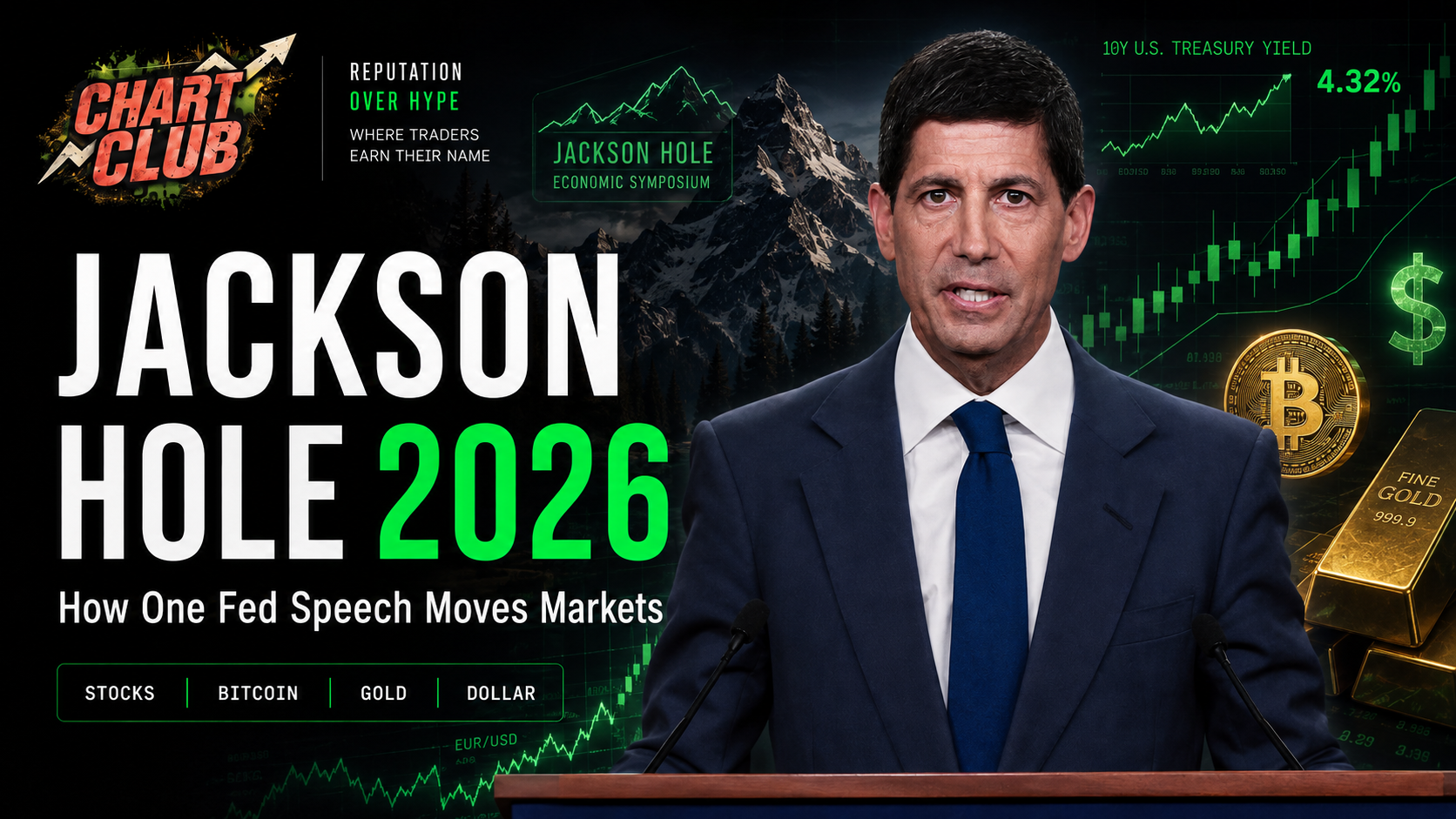
Jackson Hole 2026: What Kevin Warsh Said and Why Stocks, Bitcoin, Gold and the Dollar Are Moving
Kevin Warsh used Jackson Hole 2026 to warn that inflation remains too high while highlighting an increasingly powerful AI-driven economy. Here is what his speech means for rates, stocks, Bitcoin, gold, bonds and the US dollar.
Kevin Warsh just gave markets something they have been waiting months to hear.
Not an interest-rate decision. Not a promise of a September hike. Not another Fed dot plot.
Instead, the new Federal Reserve Chair used his first Jackson Hole keynote to explain how he sees the economy, inflation, artificial intelligence, monetary policy and the Fed itself.
The message was more hawkish than markets had been pricing.
Warsh made clear that inflation remains too high, financial conditions are not obviously restrictive, short-term interest rates remain the Fed's primary tool, and policymakers may have more work ahead if inflation does not move convincingly toward the Fed's 2% target.
Traders reacted almost immediately.
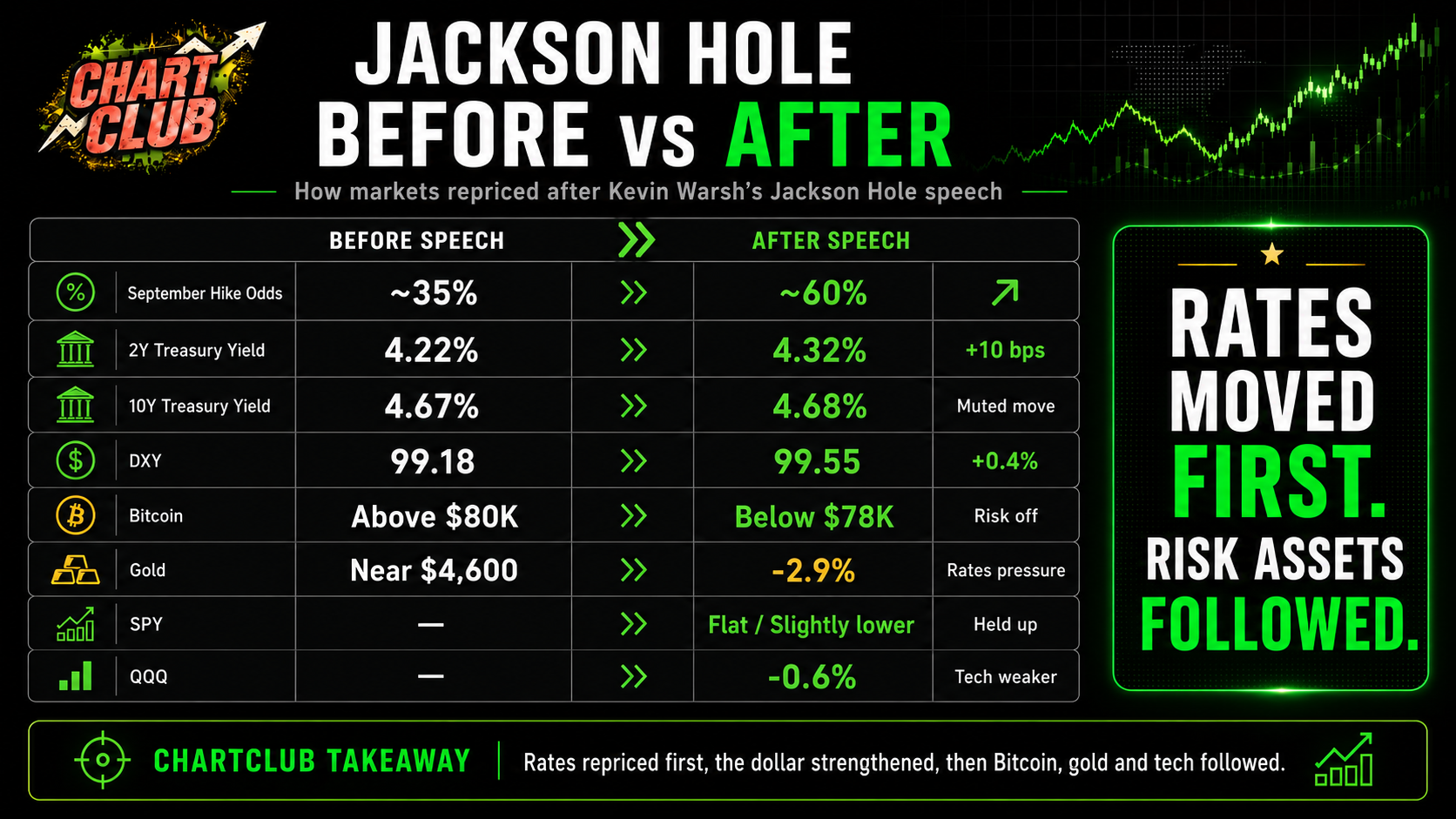
The probability of a 25 basis point September rate hike jumped from roughly 35% before the speech to around 50% afterward. The US dollar climbed. The 2-year Treasury yield jumped toward 4.29%, its highest level in roughly a month. Gold futures fell. Bitcoin slipped back below $80,000.
And yet the stock market did not collapse.
That last part might be the most interesting development of all.
The headline is not the trade. The reaction is the trade.
Let's break down exactly what Warsh said, what markets heard, and what it could mean next for stocks, Bitcoin, gold, bonds and the US dollar.
The Quick Take: What Happened at Jackson Hole?
If you only remember a few things from Warsh's speech, make them these:
Jackson Hole 2026 Key Takeaway Current Fed rate 3.50% to 3.75% July PCE inflation 3.7% YoY Fed inflation target 2% September hike odds before speech ~35% September hike odds after speech ~50% 2-year Treasury after remarks ~4.29% Dollar Index reaction +0.46% to ~99.57 Bitcoin Below $80,000, around $79,700 in the early reaction Gold futures Down roughly 1.7% following the speech Stocks Initially volatile, then broadly muted
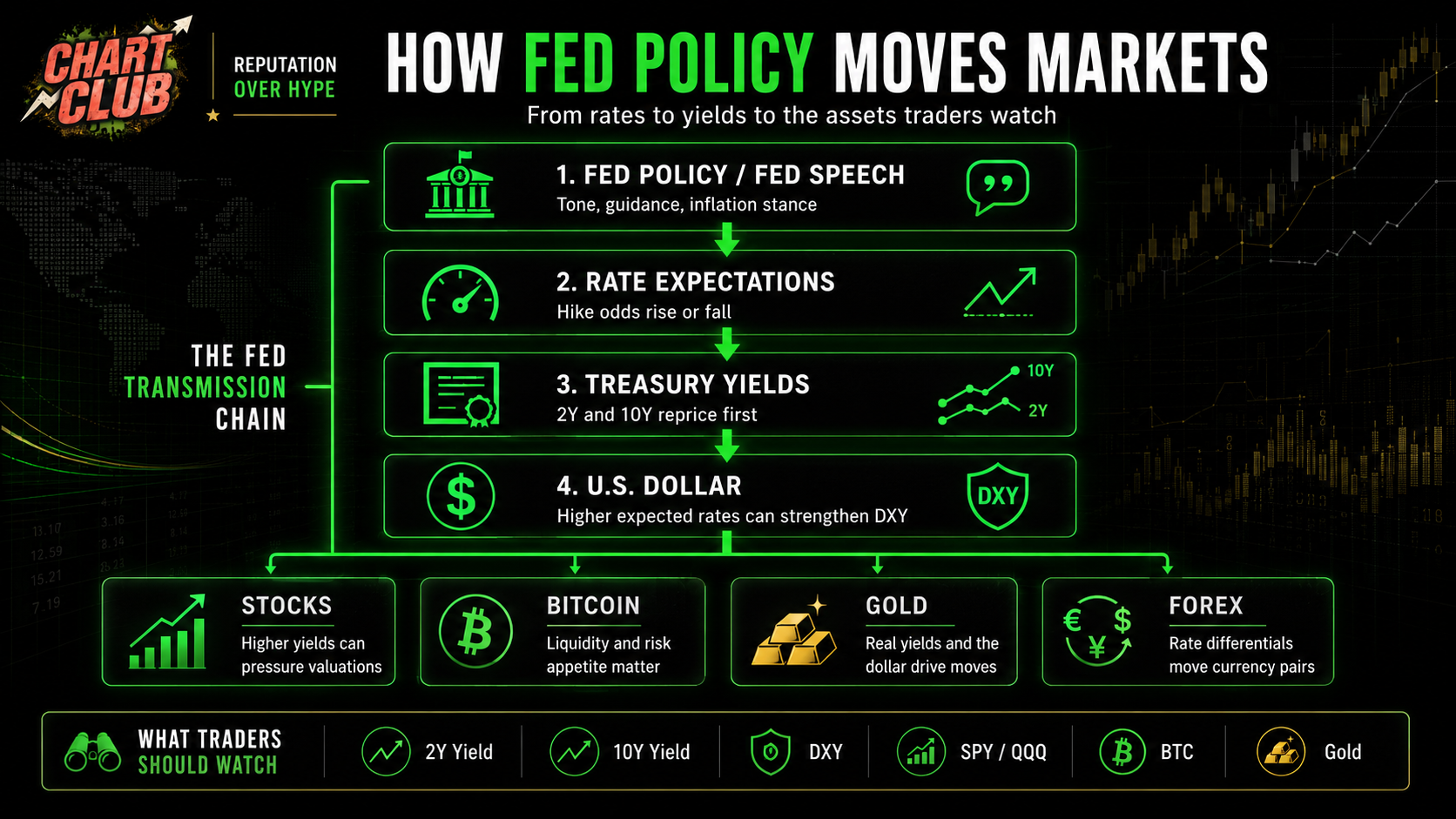
This is the best position because the reader has just seen the numbers and now gets a visual explanation of how Fed policy flows through rates, Treasury yields, the dollar and eventually stocks, Bitcoin, gold and forex.
Warsh did not promise a rate increase in September.
But he did give markets more reason to believe one is possible.
Reuters described the remarks as the closest Warsh has come so far to acknowledging that additional rate increases could be required to contain inflation.
That distinction matters.
Markets trade probabilities long before central banks make decisions.
What Did Kevin Warsh Actually Say?
Warsh's speech was titled "In Our Time."
It came on his 100th day as Federal Reserve Chair and his first appearance at Jackson Hole in that role.
He covered four major areas:
Artificial intelligence and productivity The Fed's relationship with financial markets How monetary policy should be conducted The current state of the US economy
The inflation section was what markets cared about immediately.
But the AI and communication sections may have much larger long-term implications.
- Warsh Drew a Hard Line Around the Fed's 2% Inflation Target
One of the clearest messages was that 2% remains a real target, not a loose aspiration.
Warsh called the Fed's 2% PCE inflation objective "firm" and "fixed."
That matters because current inflation remains far above it.
The Fed's preferred Personal Consumption Expenditures Price Index was running at 3.7% year over year through July.
Warsh said progress over the previous two years had been modest and that recent inflation data had not convinced him underlying trends had meaningfully improved. Reuters noted that approximately half of the components in the PCE basket were still rising at annualized rates above 3%.
His basic standard was straightforward:
If the Fed cannot become confident that inflation is moving clearly and quickly enough toward 2%, policymakers still have work to do.
That message helped push September rate-hike probabilities higher.
- Warsh Did Not Promise a September Rate Hike
This is important.
Anyone saying Warsh "announced" another hike is overstating what happened.
He did not.
Warsh repeatedly emphasized that he does not want the Federal Reserve committing itself to future decisions months in advance.
In fact, a significant section of the speech criticized modern central-bank forward guidance.
Forward guidance is essentially when central banks tell markets how they expect future policy to develop.
Warsh believes the practice has gone too far.
His concern is that if markets constantly follow the Fed's forecasts, while the Fed simultaneously reads market prices to understand expectations, both sides can become trapped in what he described as a hall-of-mirrors problem.
Put more simply:
The Fed watches the market. The market watches the Fed. Eventually, everyone may be watching everyone else instead of the economy.
That is a fascinating idea for traders.
Warsh Wants Markets to Think for Themselves
Warsh effectively told financial markets to stop waiting for the Federal Reserve to tell them what the next trade is.
He argued that the Fed needs relatively clean market signals from Treasury securities, currency markets, credit markets, commodities, asset prices, trading volumes and broader financial conditions.
But those signals become less useful if every market movement is simply a reaction to Fed communication.
That suggests a potentially major shift from the communication-heavy Fed traders became accustomed to under Ben Bernanke, Janet Yellen and Jerome Powell.
Warsh appears to want a quieter Federal Reserve.
For traders, that could mean something unexpected:
More uncertainty between meetings.
If the Fed provides less guidance, markets may need to place greater weight on economic data itself.
That could increase the importance of CPI, PCE, payrolls, unemployment, retail sales, GDP, wages, Treasury auctions, oil and inflation expectations.
It could also create more volatility around those releases.
- Short-Term Interest Rates Are Still the Fed's Main Weapon
There had been questions about whether Warsh might pursue a substantially different monetary-policy framework.
His Jackson Hole remarks provided some clarity.
He stated that short-term interest rates remain the predominant tool for achieving the Fed's employment and inflation objectives.
That matters because the conventional transmission mechanism remains intact:
Fed policy → short-term rates → Treasury yields → financial conditions → US dollar → stocks, housing, commodities and crypto
Warsh may want to reform how the Fed operates and communicates.
But the Fed funds rate is still at the center of the machine.
The Fed Funds Rate Is Already 3.50% to 3.75%
At its July 29 meeting, the Federal Reserve kept its target rate at 3.50% to 3.75%.
The decision passed by a 9-3 vote.
Beth Hammack, Neel Kashkari and Lorie Logan all wanted rates increased another 25 basis points.
That was already an unusually visible disagreement.
Now Warsh's Jackson Hole speech has moved his rhetoric closer to those inflation hawks.
Not necessarily all the way, but closer.
The September meeting just became much more interesting.
September Rate-Hike Odds Jumped to Around 50%
Before Warsh spoke, markets were pricing approximately a 35% chance of at least a 25 basis point hike in September.
Following his remarks, that probability jumped to roughly 50%.
That is a major repricing for one speech.
The Fed did not raise rates. No new inflation report was released. No jobs report hit the tape.
Warsh simply changed the market's understanding of the Fed's reaction function.
That is exactly why Jackson Hole matters.
Why the 2-Year Treasury Yield Jumped
The bond market reacted more aggressively than stocks.
The 2-year Treasury yield moved toward 4.29%, reaching its highest level in around a month following Warsh's remarks.
This is one of the cleanest signals from today's event.
The 2-year yield is highly sensitive to expectations about Federal Reserve policy.
When traders become more convinced the Fed will raise rates or keep rates elevated for longer, short-duration yields tend to increase.
That is what happened today.
The move tells us something important:
Bond traders heard Warsh as hawkish, even if equities were less impressed.
Why the 10-Year and 30-Year Bonds Reacted Differently
The long end of the Treasury curve is more complicated.
The 10-year and 30-year yields reflect much more than the next Fed meeting. They also incorporate long-term inflation, economic growth, government deficits, Treasury supply, foreign demand, fiscal credibility and term premium.
This distinction matters because the Fed directly controls very short-term policy rates.
It does not directly set the 10-year or 30-year Treasury yield.
That relationship has become especially important in 2026 because Treasury Secretary Scott Bessent has recently increased long-duration bond buybacks in an effort to influence borrowing conditions.
Reuters has described a growing tension between Bessent's approach and Warsh's preference for relatively unfiltered market price signals.
This could become one of the biggest macro stories of the next year:
Who ultimately determines the price of money?
The Fed? The Treasury? The bond market?
Most likely, some combination of all three.
Why the US Dollar Jumped After Warsh Spoke
The foreign-exchange market responded quickly.
The Dollar Index rose roughly 0.46% to 99.57, reaching an intraday high around 99.59.
EUR/USD fell about 0.46% to $1.1597.
USD/JPY climbed roughly 0.32% to 159.9.
Sterling fell approximately 0.45% to $1.3533.
Why?
Because currencies trade partly on relative interest rates.
If investors suddenly believe US rates may remain higher than previously expected, holding dollar-denominated assets can become relatively more attractive.
The chain looks something like this:
Warsh sounds hawkish → September hike odds rise → short-term Treasury yields rise → US rate advantage increases → dollar strengthens
That was one of the cleanest reactions we saw.
Why Gold Fell
Gold faced the opposite problem.
Most actively traded gold futures dropped approximately 1.7% following Warsh's remarks, according to Wall Street Journal market reporting.
Before the speech, spot gold had been trading around $4,600 per ounce, after reaching a three-month high of roughly $4,696 earlier in the week.
Gold does not produce interest.
That means higher yields create competition.
If investors can earn more on Treasury securities while the dollar simultaneously strengthens, gold can come under pressure.
An investor holding gold receives no yield.
An investor buying Treasury securities receives interest income.
When market interest rates rise, the opportunity cost of owning gold rises too.
That is why gold often reacts negatively to hawkish Fed surprises.
But the Gold Story Is Bigger Than Interest Rates
Gold has been extremely strong for reasons that go beyond monetary policy.
Investors are also thinking about US government deficits, Treasury debt, fiscal credibility, geopolitical instability, currency debasement, central-bank demand and long-term purchasing power.
That is why gold reached almost $4,700 per ounce even with US interest rates already well above zero.
The short-term question is whether rising real yields push gold lower.
The longer-term question is whether concerns about debt and fiscal credibility continue creating structural demand.
Those two forces can pull in opposite directions.
That is exactly the kind of environment where traders should avoid reducing an asset to one narrative.
Bitcoin Slipped Back Below $80,000
Bitcoin entered Jackson Hole with significant momentum.
BTC had climbed above $81,000 overnight, reaching its highest levels in roughly three months.
By the early post-speech reaction, Bitcoin had fallen back below the psychological $80,000 level and was trading around $79,700.
The move was not a crypto crash.
But it made sense.
Bitcoin had just experienced a powerful rally, and Warsh introduced a new reason for traders to reduce near-term risk.
Higher expected rates can create pressure on crypto through several channels, including higher Treasury yields, a stronger dollar, tighter liquidity, less incentive to reach for speculative returns and reduced leverage appetite.
But Bitcoin's relationship with monetary policy has become far more complicated than simply:
Rates up = BTC down.
Bitcoin Is Trading Two Narratives at Once
Bitcoin increasingly trades as both a risk asset and an alternative monetary asset.
When liquidity improves and investors want more risk, Bitcoin can trade alongside $QQQ, technology stocks, growth stocks and other speculative assets.
But Bitcoin can also rally when investors become worried about government debt, currency dilution, Treasury intervention and long-term fiat purchasing power.
That second narrative has been particularly important recently.
Bitcoin's rally above $80,000 came as investors digested the Treasury's intervention in long-duration bonds and broader concerns about what traders have called the debasement trade.
So Warsh creates an unusual setup for BTC.
A more disciplined, inflation-focused Federal Reserve could strengthen confidence in the dollar and pressure Bitcoin.
At the same time, concerns surrounding fiscal policy and government debt could increase demand for scarce alternative assets.
That tension is worth watching.
Why Stocks Did Not Collapse
This was arguably today's most surprising reaction.
Warsh sounded hawkish. Rate-hike probabilities increased. Short-term Treasury yields rose. The dollar strengthened. Gold fell.
Yet the stock market remained relatively calm.
Reuters reported that after the speech the major US indexes were broadly muted, with the Dow slightly positive while the S&P 500 and Nasdaq were only modestly lower.
Why?
There are several possible explanations.
Explanation 1: Warsh Was Hawkish, But Not Shockingly Hawkish
Markets had already expected Warsh to take inflation seriously.
Several Fed officials had warned about sticky inflation before his speech.
So while Warsh moved expectations, he did not shock traders with a statement such as:
"We need to raise rates immediately."
He remained deliberately noncommittal about the September meeting.
That distinction may have prevented a much larger equity selloff.
Explanation 2: Stocks Are Trading the AI Boom Too
There is another enormous force in the market right now:
Artificial intelligence.
Nvidia had surged 8.7% on Thursday following a powerful outlook that helped push the Nasdaq up 1.57% and the S&P 500 technology sector up 3.4%.
The AI trade remains one of the strongest capital-attraction stories in global markets.
And Warsh himself acknowledged that.
This was not just a Fed inflation speech.
It was also surprisingly bullish commentary on US productivity.
AI Was One of the Biggest Themes in Warsh's Speech
Warsh described the economy as potentially reaching a major technological turning point.
He argued that rapid advances in artificial intelligence could substantially raise future economic growth.
Then he gave markets some numbers.
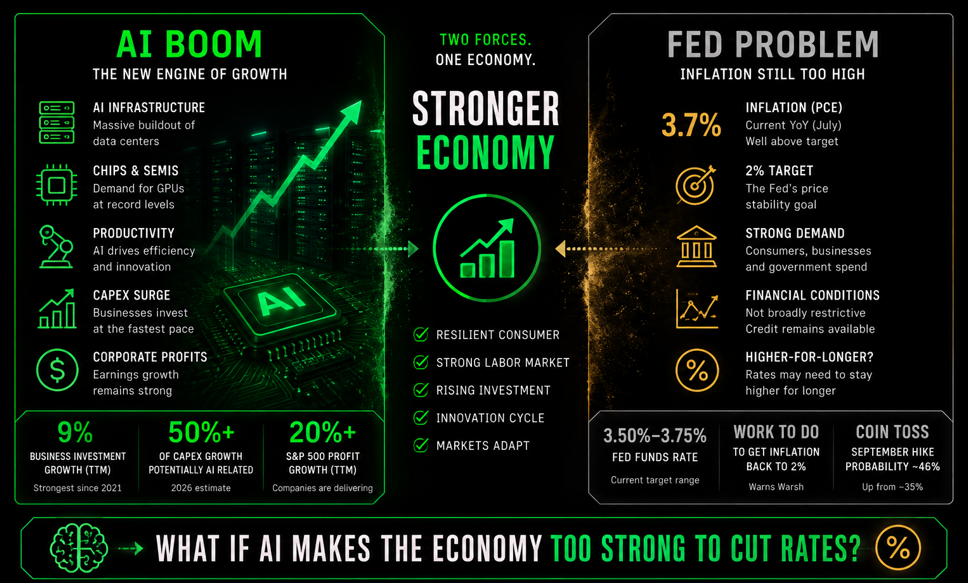
Business investment in equipment and intangible assets has grown roughly 9% over the previous four quarters, its strongest growth rate since 2021.
Warsh estimated that more than half of this year's capital-expenditure growth may be attributable to the AI buildout.
He also noted that S&P 500 company profits had increased by more than 20% over the previous year.
Those are significant numbers.
And they create one of the most important macro debates heading into 2027.
The AI Boom Could Make the Fed's Job Harder
Normally, stronger economic growth sounds bullish.
But central banking is rarely that simple.
Suppose AI dramatically improves productivity. Companies become more profitable. Investment increases. Workers produce more. Economic growth accelerates.
That could allow the economy to grow faster without generating as much inflation.
That would be bullish.
But there is another possibility.
AI investment creates enormous capital spending. Stock-market wealth rises. Corporate profits increase. Credit remains available. Consumers continue spending. Aggregate demand stays strong.
Inflation remains sticky.
Now the Fed may have to keep rates higher even while the economy performs well.
Instead of:
weak economy + lower rates
we could get:
strong economy + higher rates
That combination could become one of the defining market themes of the next few years.
Warsh Thinks the US Economy Has Strengthened
Warsh did not describe an economy on the edge of recession.
Quite the opposite.
He said he was impressed by the economy's overall performance and resilience.
Main Street and Wall Street have held up despite geopolitical conflict, higher borrowing costs, trade uncertainty, inflation and volatile energy markets.
The labor market has also remained relatively stable.
That reduces the urgency for the Fed to cut rates and potentially gives policymakers more room to fight inflation.
This matters for investors who are still operating with the old assumption that:
High rates must eventually cause a recession.
Maybe.
But that has not happened yet.
The New Fed Problem: What If Rates Are Not Actually Restrictive?
This could be the most important macro question to come out of Jackson Hole.
The Fed funds rate is already 3.50% to 3.75%.
Normally, that might be expected to slow activity.
Yet business investment is strong, AI spending is booming, S&P 500 profits are up more than 20%, equity volatility remains relatively low and economic activity is resilient.
So what if 3.50% to 3.75% is not particularly restrictive anymore?
That changes everything.
It could mean the so-called neutral interest rate has risen.
The neutral rate is the theoretical interest rate that neither stimulates nor restricts economic activity.
Nobody can observe it directly. Economists estimate it.
If neutral has moved higher because of productivity, AI investment, government borrowing, capital demand or structural economic changes, then the Fed may need higher interest rates than markets became accustomed to during the post-2008 period.
That would affect almost every major asset class.
Higher-for-Longer Rates Would Change the Market Math
For years, investors benefited from extremely cheap money.
Low rates supported technology valuations, real estate, venture capital, private equity, unprofitable growth companies, leveraged strategies and eventually crypto speculation.
A structurally higher-rate environment changes the equation.
Companies need stronger cash flows. Debt costs more. Weak balance sheets matter more. Capital allocation matters more. Profitability matters more.
Risk-free Treasury yields become legitimate competition for stocks.
This does not mean equities cannot rise.
Nvidia is living proof that companies with extraordinary earnings growth can outperform even with higher rates.
It simply means investors become more selective.
Small-Cap Traders Should Pay Attention
This has direct relevance for ChartClub.
Fed policy does not only move mega-cap names and indexes.
Small-cap companies can be particularly sensitive to interest rates because many have higher financing costs, less predictable cash flow, greater refinancing needs, more floating-rate debt and less access to cheap capital.
That means a sustained higher-rate environment can create sharper separation between strong and weak companies.
For traders, this can produce both opportunity and risk.
A small-cap momentum ticker may still explode on FDA news, an acquisition, earnings, a contract, clinical data or another catalyst.
But the broader liquidity environment still matters.
A risk-off macro session can reduce follow-through.
A risk-on environment can amplify it.
The catalyst matters. The tape matters too.
Jackson Hole Is a Reminder That Markets Are Connected
A lot of traders specialize in one market.
Stocks. Crypto. Forex. Gold. Options.
That is fine.
But major macro events demonstrate why understanding cross-asset relationships matters.
Today gave us a textbook example:
Warsh speaks → September hike expectations rise → 2-year Treasury yield rises → dollar strengthens → gold falls → Bitcoin loses momentum → growth stocks face higher discount rates
That is one event flowing through multiple markets.
At ChartClub, this is exactly why we pay attention to more than one ticker.
The 2022 Jackson Hole Lesson
Jackson Hole has produced major market moves before.
The most famous recent example happened in 2022.
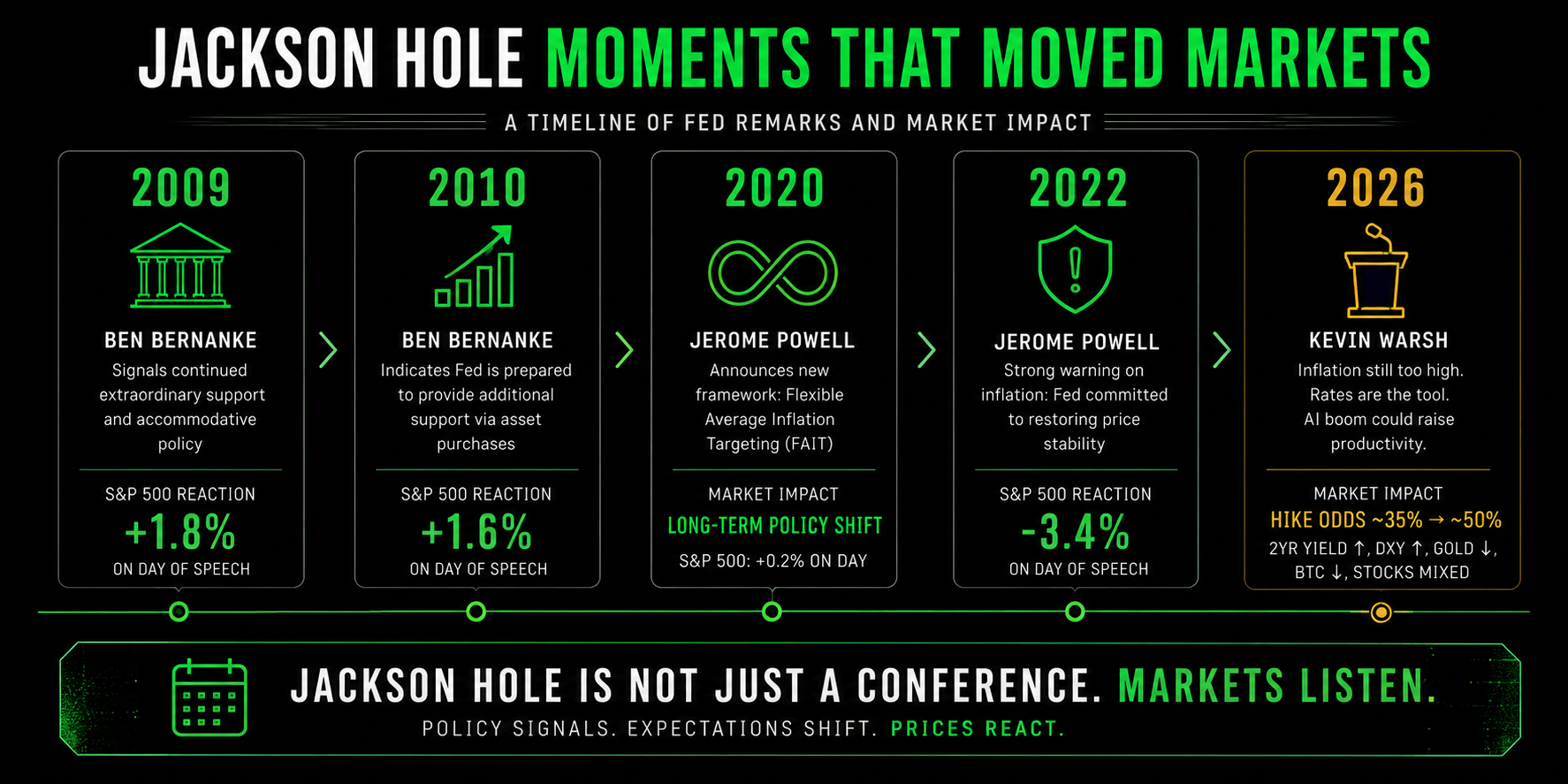
Jerome Powell used a short speech to make clear that the Federal Reserve was committed to defeating inflation even if doing so created economic pain.
The S&P 500 plunged approximately 3.4% that day.
That move became one of the defining moments of the 2022 bear market.
But Jackson Hole has produced bullish reactions too.
In 2009, Ben Bernanke's remarks helped the S&P 500 rise roughly 1.8%.
In 2010, the index climbed another 1.6% as Bernanke indicated the Fed was prepared to provide additional support through bond purchases.
Then in 2020, Powell used Jackson Hole to announce a major shift in the Fed's inflation framework.
The S&P 500 only gained about 0.2% that day, but the policy consequences lasted much longer than the immediate market move.
Sometimes Jackson Hole moves markets immediately.
Sometimes it changes the framework investors use for years.
Warsh's 2026 speech may eventually fall into the second category.
Why Warsh's Attack on Forward Guidance Matters Long Term
For years, traders became accustomed to phrases like "data dependent," "higher for longer," "appropriate policy path," and detailed Fed projections.
Warsh wants less of that.
If he succeeds, the Fed may become more difficult to predict from speeches alone.
Markets may become less obsessed with decoding every adjective from every Fed governor and more focused on actual inflation, actual jobs, actual productivity, actual financial conditions and actual market pricing.
That sounds obvious.
But modern markets have spent years treating central-bank communication almost like a trading indicator.
Warsh seems determined to change that.
Reuters described his broader project as an effort to rethink a communication system he believes has become excessively transparent and potentially counterproductive.
For traders, less guidance could mean more price discovery.
It could also mean more volatility.
What Happens Next?
Jackson Hole is over for Warsh.
The Fed debate is not.
The next major FOMC meeting is scheduled for September 15 and 16, 2026.
And the market has essentially turned that meeting into a coin toss.
A roughly 50% probability means the next few economic releases could create substantial repricing.
Inflation
Does PCE and CPI finally start moving convincingly back toward 2%?
Employment
Does the labor market remain resilient or weaken?
Oil and Energy
A renewed energy spike could complicate inflation again.
AI Investment
Does the capital-expenditure boom continue?
Treasury Yields
Do long-term borrowing costs remain close to multi-decade highs?
The US Dollar
Does DXY continue strengthening as markets price tighter Fed policy?
Financial Conditions
Do stocks, credit and liquidity remain easy enough that the Fed feels additional tightening is necessary?
The Next Jobs Report Could Change Everything
Markets may not have to wait very long.
The upcoming US employment report is expected to be closely watched after recent labor-market softness.
Reuters reported economists expect roughly 45,000 jobs to be added in August, following a surprise decline in employment in July.
The combinations matter.
Hot jobs + sticky inflation: September hike probability could rise considerably.
Weak jobs + sticky inflation: The Fed faces a difficult stagflation-style tradeoff.
Weak jobs + softer inflation: Rate-hike expectations could collapse.
Strong jobs + softer inflation: The soft-landing narrative could return.
Jackson Hole moved the probabilities.
The data will decide whether the move sticks.
The Bull Case After Jackson Hole
There is still a legitimate bullish argument for stocks.
Warsh may be concerned about inflation, but the US economy is not obviously deteriorating.
AI investment remains enormous. Corporate earnings are strong. Business investment is accelerating. Productivity could rise.
If AI-driven productivity allows companies to grow profits while inflation gradually declines, higher rates may become less damaging than traditional models suggest.
That could produce an unusual outcome:
Higher interest rates with higher stock prices.
The strongest businesses could continue compounding because earnings growth offsets valuation pressure.
That would especially benefit companies with strong cash generation, high margins, low debt, pricing power and exposure to secular growth trends.
The Bear Case After Jackson Hole
The danger is straightforward.
Inflation is still 3.7%.
The Fed wants 2%.
If economic demand stays strong while inflation refuses to fall, rates may need to rise again.
That creates pressure on equity valuations, housing, corporate borrowing, consumer credit, small-cap financing, crypto liquidity and speculative assets.
The market also faces an uncomfortable fiscal backdrop.
Government borrowing remains large. Long-term Treasury yields remain elevated. The Treasury has already intervened more aggressively in long-duration debt markets.
If inflation and fiscal concerns collide, financial conditions could tighten even without an aggressive Fed hiking cycle.
That is the risk investors cannot ignore.
What Should Traders Watch on the Charts Now?
After a major catalyst, the question changes.
Before the speech:
What will Warsh say?
After the speech:
Can the market hold the move?
That second question is much more useful.
$SPY
Watch whether the broad market can remain resilient despite higher short-term yields.
If equities refuse to sell while Fed expectations become more hawkish, that is relative strength.
$QQQ
Technology is more sensitive to discount rates, but AI earnings remain a powerful counterforce.
Watch whether the AI-driven rally can regain momentum.
$IWM
Small caps can provide a cleaner read on financing sensitivity and domestic risk appetite.
$BTC
The $80,000 area has become an obvious psychological level.
A sustained reclaim would suggest crypto remains resilient to tighter-rate expectations. Repeated rejection could indicate momentum is cooling.
Gold
Watch whether the rate-driven decline finds buyers.
If gold holds relatively firm despite a stronger dollar and rising short-term yields, the fiscal and debasement narrative may still be powerful.
DXY
The dollar around 99.5 is one of the clearest macro confirmation signals.
Continued strength would reinforce the higher-rate interpretation.
2-Year Treasury Yield
This might be the most important chart of them all.
If the 2-year keeps climbing, traders are continuing to price a tighter Fed.
If it reverses, September hike expectations may be cooling.
For Day Traders: Do Not Chase the First Macro Candle
Major Fed events create enormous algorithmic activity.
Computer systems scan speeches instantly. Keywords hit news terminals. Treasury futures move. Currency algorithms react. Equities follow. Crypto trades 24/7 and responds immediately.
Then human investors read the full speech.
That is why the first move often reverses.
A good trader does not need to win the race against machines.
There is no trophy for buying or shorting the first 30-second candle.
Sometimes the better opportunity arrives after the first spike, the liquidity sweep, the pullback, the VWAP test, the failed breakout or confirmation from another market.
Use Cross-Market Confirmation
Suppose $QQQ starts falling.
Do not automatically assume:
Fed hawkish = short.
Look around.
Is the 2-year yield still rising? Is DXY strengthening? Is $SPY losing VWAP? Is Bitcoin weakening? Are semiconductors breaking support? Is market breadth deteriorating?
If several markets confirm the same story, the trade has more context.
Now imagine $QQQ falls initially but Treasury yields reverse lower, DXY gives back its gains, Bitcoin reclaims $80,000 and $SPY moves back above VWAP.
The original bearish thesis is weakening.
That is the difference between reacting to a headline and reading the market.
This Is Exactly Why VWAP Matters
VWAP can be particularly useful on catalyst-heavy sessions.
Suppose an index sells sharply after a Fed speech.
Instead of chasing the downside, ask:
Does price stay below VWAP? Does a bounce reject there? Does volume expand on the rejection? Do Treasury yields remain elevated? Does DXY hold strength?
If yes, there may be real continuation.
If price immediately reclaims VWAP and holds, the original selloff could simply have been an algorithmic overreaction.
The macro story provides context. The chart provides the trade.
The Biggest Lesson From Jackson Hole 2026
Kevin Warsh did not give Wall Street the clean answer it wanted.
That may have been intentional.
His message was essentially this:
Inflation is still too high. The economy is stronger than expected. AI may transform productivity. Interest rates remain the Fed's primary tool. The Fed should communicate less. Policymakers will make decisions when they actually have to make them.
Markets translated that into higher September hike odds.
But stocks did not panic.
That is the lesson.
Markets do not simply trade whether news sounds good or bad.
They trade expectations, positioning, liquidity, probabilities, valuations and what was already priced in.
ChartClub Takeaway: The Headline Is Not the Trade
Jackson Hole gives traders a perfect real-world example of how markets actually function.
Warsh's speech was hawkish.
That is the headline.
But that alone does not tell you what to trade.
The actual information came from the reaction:
2-year yields: higher September hike odds: higher US dollar: higher Gold: lower Bitcoin: softer Stocks: surprisingly resilient
Now we have information.
The strength in stocks matters because it tells us investors are not currently treating tighter Fed expectations as an immediate threat large enough to overpower earnings and AI enthusiasm.
The weakness in gold and strength in the dollar tell us rate expectations still matter.
Bitcoin's reaction tells us the battle between liquidity-sensitive speculation and the debasement narrative is very much alive.
And the bond market tells us traders took Warsh seriously.
That is how we should approach markets at ChartClub.
Not by trying to predict everything.
Instead:
Understand the catalyst. Watch the reaction. Identify confirmation. Define invalidation. Manage risk.
Final Thoughts
Jackson Hole 2026 may eventually be remembered for more than whether the Federal Reserve raises rates in September.
Kevin Warsh laid out something much broader.
He wants a Federal Reserve that communicates less. He wants markets to rely more heavily on real economic information. He views the 2% inflation target as non-negotiable. He believes interest rates remain the primary policy tool. He sees artificial intelligence as potentially transformative for productivity and economic growth.
And he does not appear convinced that today's financial conditions are sufficiently restrictive to guarantee inflation returns to target.
That combination could define the next phase of this market.
The economy may be stronger than traditional models suggest. AI may increase productivity. Corporate profits may keep growing.
But stronger growth may also allow inflation to remain stubborn.
If that happens, investors could find themselves operating in a market that looks very different from the low-rate world of the previous decade.
Higher rates. Higher productivity. Higher corporate profits. Higher Treasury yields.
And potentially much greater separation between winners and losers.
For traders, the next move will not be decided by one speech.
It will be decided by inflation, jobs, Treasury yields, the dollar, corporate earnings, Bitcoin, gold and ultimately price.
Warsh gave markets the catalyst.
Now the charts get the final vote.