US Jobs Report: The Data That Could Decide the September Fed Trade
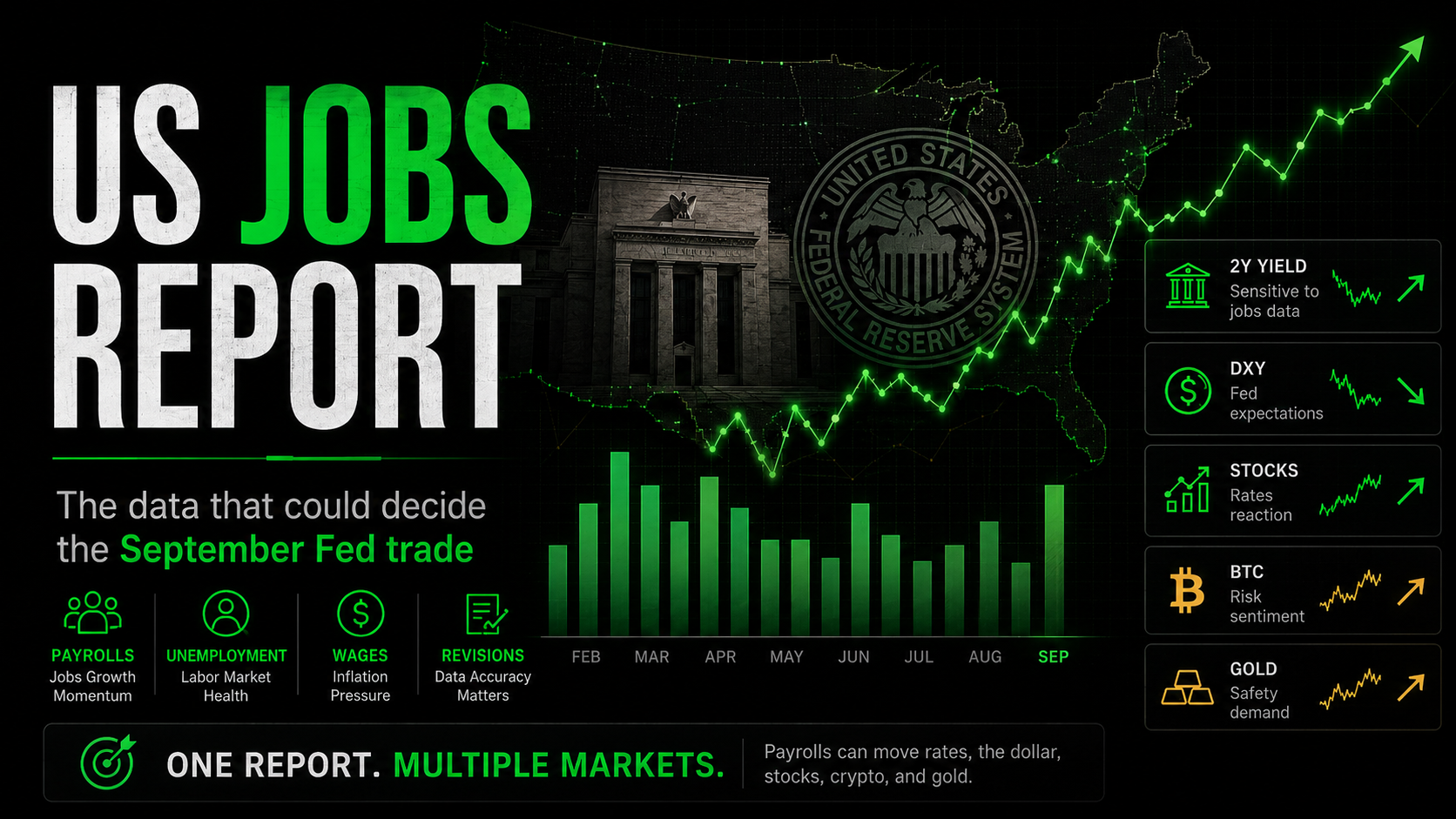
After Kevin Warsh's hawkish Jackson Hole reset, Friday's US jobs report becomes the next major test for markets. Payrolls, wages and unemployment could determine whether Treasury yields and the dollar keep rising, or whether stocks, Bitcoin and gold get relief.
US Jobs Report: The Data That Could Decide the September Fed Trade
The Federal Reserve just spent Jackson Hole telling markets that inflation is still too high.
Now the labor market gets a vote.
At 8:30 a.m. ET on Friday, September 4, the US Bureau of Labor Statistics will release the August Employment Situation report, including nonfarm payrolls, unemployment, wage growth, labor-force participation and revisions to previous months.
Normally, that would already make it one of the biggest economic releases of the month.
This time, the stakes are considerably higher.
Federal Reserve Chair Kevin Warsh just used his Jackson Hole speech to push back against the idea that inflation is under control. Markets responded by increasing the probability of a September rate hike from roughly 35.4% before the speech to 55.7% afterward.
The 2-year Treasury yield jumped nearly 13 basis points to 4.36% on Friday. The US dollar recorded its biggest daily gain in roughly two and a half months. Bitcoin fell 3.34%. Gold dropped 3.19%. The Nasdaq declined 0.52%, while the rate-sensitive Russell 2000 lost 1.4%.
Friday's jobs report now has an obvious question to answer:
Is the US economy strong enough for the Fed to raise rates again, or is the labor market already weakening enough to make another hike dangerous?
That question could set the tone for stocks, bonds, forex and crypto heading into the September 15 to 16 FOMC meeting.
And the answer may not be as simple as whether the headline payroll number beats or misses expectations.
When Is the August US Jobs Report?
The Bureau of Labor Statistics has scheduled the August Employment Situation report for:
Friday, September 4, 2026 8:30 a.m. ET
The report arrives less than two weeks before the Federal Reserve's September 15 to 16 policy meeting.
Official BLS Employment Situation schedule
That timing makes this report especially important.
There will still be additional data before the Fed meets, including the August CPI report on September 11, but payrolls will be the first major test of the hawkish expectations markets built following Jackson Hole.
The Setup: The Fed Has an Inflation Problem and a Labor-Market Question
The Federal Reserve's situation is uncomfortable.
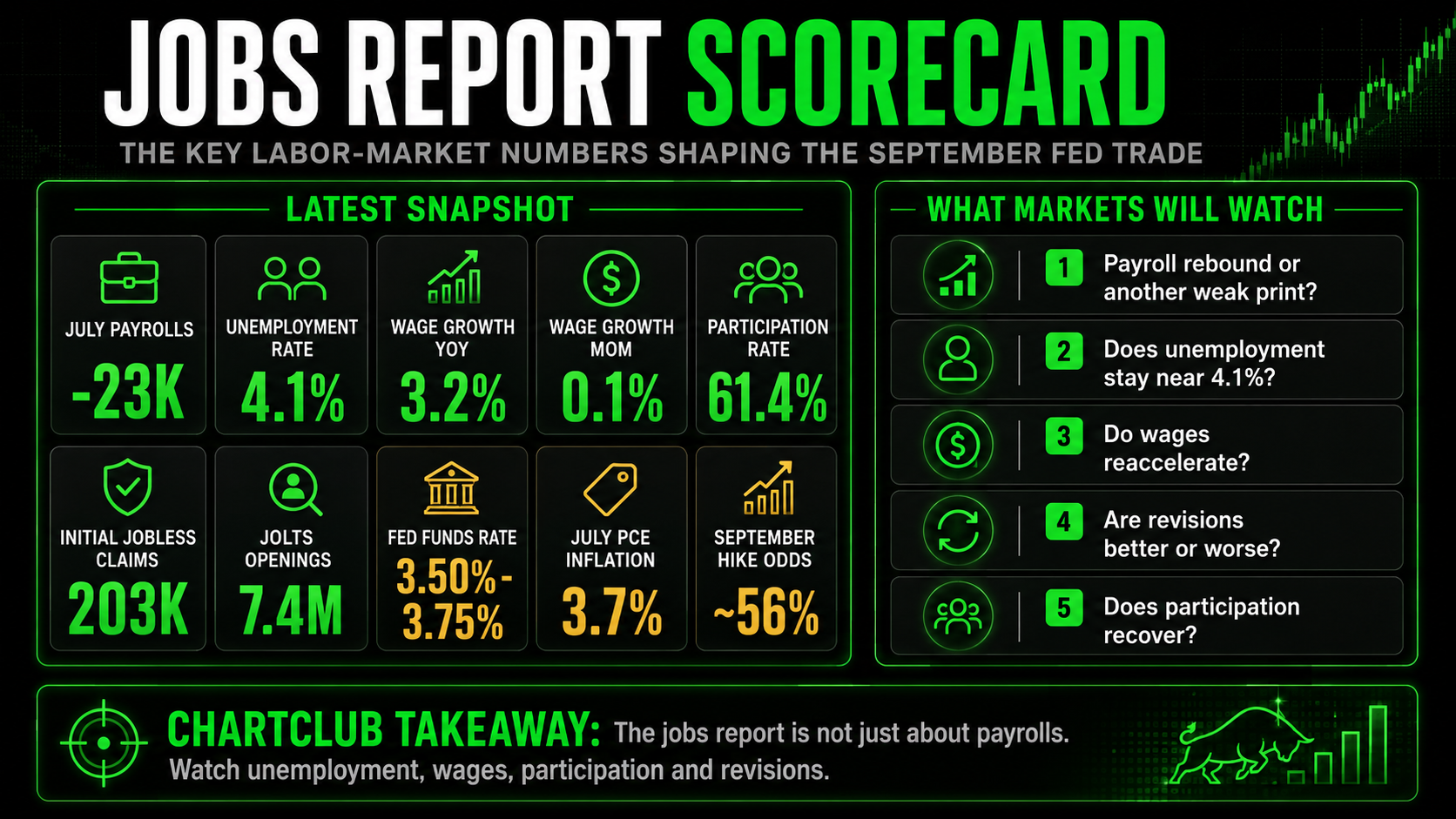
Its target rate currently sits at 3.50% to 3.75%.
At the July FOMC meeting, policymakers voted 9-3 to leave rates unchanged. Beth Hammack, Neel Kashkari and Lorie Logan dissented because they wanted another 25 basis point increase.
Then inflation moved in the wrong direction.
July headline PCE inflation increased to 3.7% year over year, from 3.6% in June.
Core PCE, which excludes food and energy, remained at 3.3%.
The Fed wants inflation around 2%.
So on inflation alone, there is a reasonable argument for tighter monetary policy.
The labor market is where things become complicated.
July's Jobs Report Was a Warning Shot
The previous employment report surprised markets badly.
US nonfarm payrolls fell by 23,000 in July, the first monthly decline in five months.
Economists had expected an increase.
Even more importantly, previous months were revised lower.
May payroll growth was cut from +129,000 to +63,000. June was revised from +57,000 to +20,000. Combined, May and June employment was 103,000 jobs lower than previously reported.
That changed the labor-market narrative.
Instead of one weak month, traders were looking at several months of deteriorating momentum.
The unemployment rate still declined from 4.2% to 4.1%, but even that headline came with an important caveat.
Roughly 264,000 people left the labor force, pushing participation down to 61.4%, its lowest level in about five and a half years.
That is why traders need to look beyond the unemployment rate itself.
Sometimes unemployment falls because more people find jobs.
Sometimes it falls because fewer people are actively looking for work.
Those are very different economic signals.
Wage Growth Is Cooling Too
Average hourly earnings increased just 0.1% month over month in July.
Annual wage growth slowed to approximately 3.2%.
For workers, slower wage growth is not necessarily welcome.
For the Federal Reserve, however, cooling wages can reduce one potential source of inflation pressure.
The upcoming August report will therefore be about more than payrolls.
Traders should watch three major headline numbers together:
Indicator July What Markets Are Watching Nonfarm payrolls -23K Does hiring recover? Unemployment 4.1% Does weakness finally push it higher? Wage growth YoY 3.2% Are labor-cost pressures returning? Wage growth MoM 0.1% Does monthly growth rebound? Participation rate 61.4% Does labor supply recover?
What Does Wall Street Expect for August Payrolls?
Forecasts are unusually dispersed, which itself tells us something about the uncertainty surrounding the labor market.
Recent Reuters reporting has put expected August job creation somewhere around 45,000 to 58,000, while the Financial Times cites a roughly 50,000-job consensus.
The unemployment rate is generally expected to remain around 4.1%, although some forecasts see a possible move toward 4.2%.
That is weak employment growth by historical standards.
It would still represent an improvement from July's 23,000-job decline.
But a payroll number near 50,000 would hardly suggest an economy experiencing a hiring boom.
And that is where Friday becomes interesting.
The Labor Market Looks Like "Slow Hire, Slow Fire"
One of the best ways to describe the current labor market is:
Companies are not hiring aggressively, but they are not firing aggressively either.
The data support that idea.
Initial unemployment claims recently fell to just 203,000, down 4,000 from the previous week.
Continuing claims fell to approximately 1.778 million, their lowest level in a month.
Those are not recessionary layoff numbers.
At the same time, job openings and hiring have clearly cooled from the post-pandemic boom.
The latest JOLTS report showed approximately:
7.4 million job openings 5.3 million hires 5.4 million total separations 3.2 million quits 1.8 million layoffs and discharges
in June.
BLS Job Openings and Labor Turnover data
This is not a labor market falling apart.
It is a labor market that appears to be losing momentum.
That distinction is critical for the Fed.
Tuesday Gives Us an Early Preview
Traders will not have to wait until Friday for labor-market information.
The BLS will publish the July JOLTS report on Tuesday, September 1 at 10:00 a.m. ET.
That report will provide a fresh look at job openings, hiring, layoffs and quits.
Job openings are useful because they tell us about employer demand before someone actually gets hired.
The quits rate can be equally revealing.
Workers are generally more willing to voluntarily leave their jobs when they believe finding another job will be relatively easy.
A falling quits rate can therefore signal deteriorating employee confidence even when layoffs remain low.
The June quits rate was about 2.0%, consistent with a labor market that has cooled substantially from the extremely tight conditions seen earlier in the decade.
The Jobs Numbers Are Not as Precise as They Look
This is something traders should understand.
When a payroll report says:
+50,000 jobs
it does not mean exactly 50,000 people were hired.
Payroll estimates are survey-based and routinely revised as additional information becomes available.
We just received another reminder.
On August 28, the BLS released its preliminary annual benchmark revision for March 2026.
It estimated that total nonfarm employment was 79,000 jobs lower than previously calculated.
Private employment was estimated to be 178,000 lower.
The revision itself was relatively small compared with the size of the US workforce, just 0.1% of total nonfarm employment.
But it reinforces an important trading lesson:
Do not treat one payroll number as absolute truth.
The direction, revisions, unemployment rate, wages, participation and broader trend all matter.
BLS preliminary 2026 employment benchmark revision
Why Friday Matters So Much for the Federal Reserve
Kevin Warsh changed the conversation at Jackson Hole.
Before his speech, markets saw approximately a 35.4% probability of a September rate hike.
Afterward, those odds increased to roughly 55.7%.
Warsh did not promise a hike.
But he said the Federal Reserve would still have "work to do" if policymakers could not become confident underlying inflation was returning toward the 2% target.
He also argued that financial conditions do not appear broadly restrictive.
That is important.
If financial conditions remain easy, economic growth remains resilient and inflation is 3.7%, the Fed has a stronger argument for another hike.
Unless the labor market gives them a reason not to.
Friday Is Really a Test of the Fed's Dual Mandate
The Federal Reserve has two main economic objectives:
Price stability
and
maximum employment.
Right now those objectives could be starting to conflict.
Inflation says:
Stay restrictive, possibly tighten further.
Weak payroll growth says:
Be careful.
This is what makes the August employment report more important than a standard NFP release.
If employment rebounds strongly, the Fed has more freedom to attack inflation.
If employment deteriorates further, raising rates becomes considerably more difficult.
Four Jobs Report Scenarios Traders Should Understand
These are not predictions. They are useful ways to think about how markets could interpret Friday's data.
Scenario Possible Data Likely Fed Interpretation Possible Market Reaction Hot labor report Payrolls well above expectations, unemployment 4.0%-4.1%, firm wages Economy can tolerate tighter policy 2Y ↑, DXY ↑, gold ↓, BTC pressure, rate-sensitive stocks weaker Goldilocks report Moderate job growth, unemployment near 4.1%, wages contained Growth continues without major labor inflation Stocks potentially positive, yields relatively stable Weak labor report Payrolls near zero or negative, unemployment rises September hike becomes harder to justify 2Y ↓, DXY ↓, gold/BTC potentially higher Stagflation-style report Weak jobs but unexpectedly strong wages Fed faces conflicting signals Potentially volatile and directionally messy
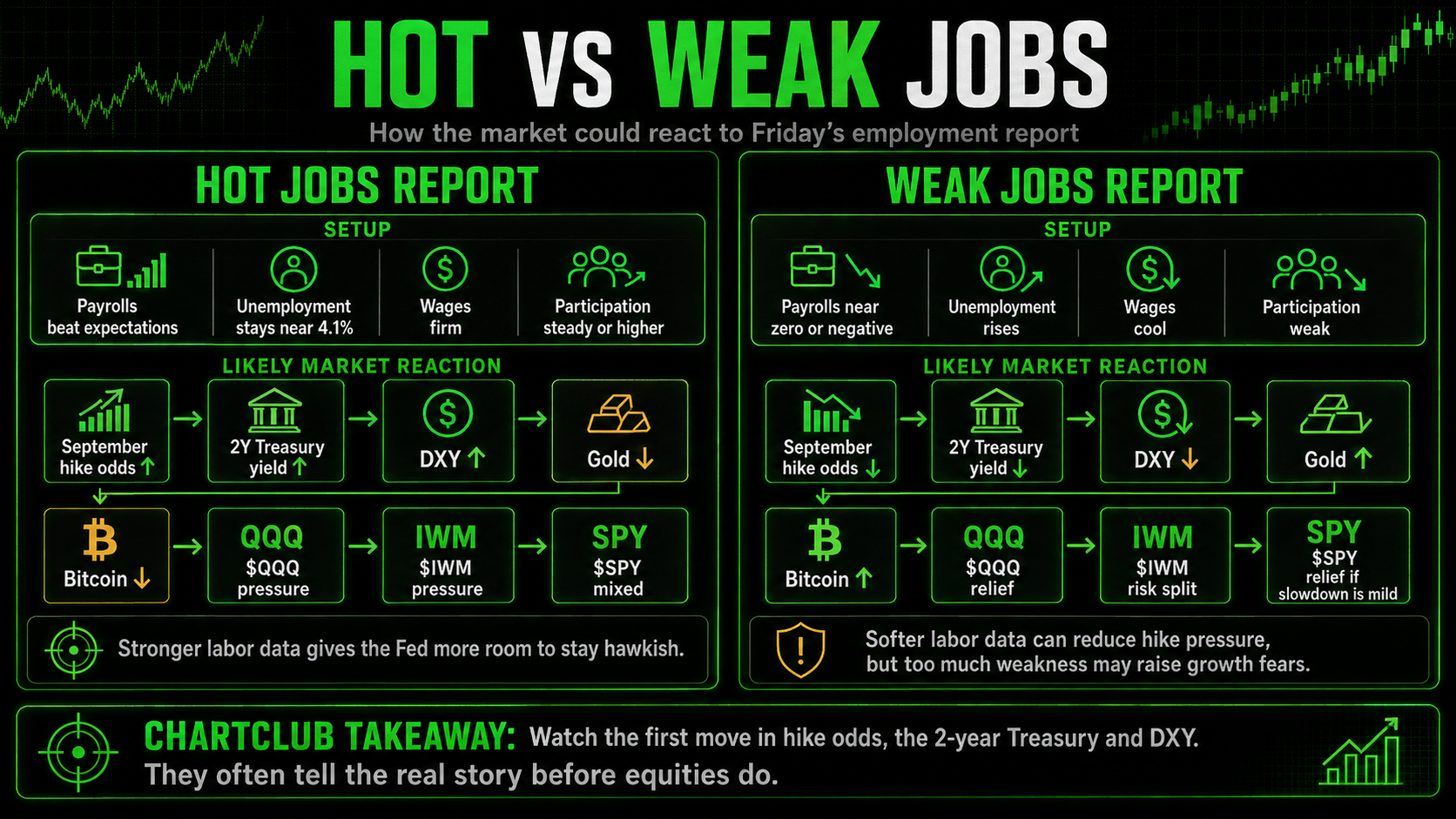
That last scenario deserves attention.
A weak payroll number is not automatically bullish.
If unemployment rises sharply because the economy is genuinely deteriorating, investors may stop celebrating lower rate expectations and start worrying about earnings and recession risk.
This is why:
bad economic news does not always equal good market news.
What a Hot Jobs Report Could Mean
Suppose payrolls dramatically beat expectations.
Instead of 45,000 to 60,000 new jobs, imagine the report comes in comfortably above 100,000.
The unemployment rate stays around 4.1%.
Wages rebound.
Participation improves.
That would make it harder to argue the economy urgently needs monetary support.
With PCE inflation already at 3.7%, markets could increase the probability of a September hike materially above its current mid-50% range.
The first place I would look for confirmation is the 2-year Treasury yield.
That is because the 2-year reacts strongly to expectations around near-term Federal Reserve policy.
It ended Friday near 4.36% after Warsh's Jackson Hole speech.
If a hot payroll report pushes the 2-year materially higher again, bond traders would be saying:
We think the Fed is going to tighten.
What a Weak Jobs Report Could Mean
Now imagine another negative payroll print.
Unemployment rises.
Participation does not recover.
Previous months are revised even lower.
That could cause traders to rapidly unwind September hike expectations.
The 2-year Treasury yield could fall.
The dollar could weaken.
Gold could rebound.
Bitcoin could regain some of the liquidity-driven demand lost following Jackson Hole.
Technology shares might initially rally as discount-rate pressure eases.
But there is an important line traders need to recognize.
At some point:
weak enough to stop the Fed
can become:
weak enough to worry investors about the economy.
That is where a seemingly bullish rates reaction can become bearish for equities.
Why $SPY Could React Differently From $QQQ
Interest rates do not affect every stock equally.
Growth companies are generally more sensitive to changes in discount rates because investors are assigning significant value to earnings expected years into the future.
That makes $QQQ particularly important around Fed-sensitive data.
A strong jobs report that pushes yields higher could pressure technology valuations.
But there is a competing force.
AI-related earnings growth remains extraordinarily strong.
S&P 500 second-quarter earnings are currently on pace to rise approximately 34.5% year over year, while AI infrastructure spending continues to support major technology companies.
So the market is balancing two powerful forces:
higher rates
versus
higher earnings.
That battle could continue throughout September.
Why Small Caps Could Be Even More Sensitive
For ChartClub traders, watch $IWM closely.
The Russell 2000 fell roughly 1.4% Friday after Warsh pushed rate expectations higher.
That makes sense.
Smaller companies tend to have:
more expensive financing, less predictable cash flow, higher refinancing needs, and greater sensitivity to domestic economic conditions.
A hot jobs report could hurt small caps through higher borrowing costs.
A very weak report could hurt them through growth concerns.
That puts small caps in an interesting middle ground.
The best environment may be a moderately healthy labor market with cooling inflation.
In other words:
good enough growth without a reason for the Fed to tighten aggressively.
Why the Jobs Report Matters for Bitcoin
Bitcoin enters this report from a particularly interesting position.
BTC had recently climbed above $81,000, supported by strong risk appetite, renewed ETF inflows and concerns around US debt and dollar debasement.
Then Warsh spoke.
The dollar strengthened.
Treasury yields jumped.
Bitcoin dropped 3.34% Friday to around $77,414.
That was a reminder that Bitcoin still trades as a liquidity-sensitive risk asset.
A hot jobs report could reinforce:
higher rates → stronger dollar → tighter liquidity → pressure on BTC
A weak report could trigger the opposite reaction.
But Bitcoin also has its debasement narrative.
That means BTC could eventually benefit from concerns around fiscal deficits, Treasury intervention and long-term dollar purchasing power even while responding negatively to tighter short-term monetary policy.
That tension is one of the most interesting trades in crypto heading into September.
Why Forex Traders Should Watch DXY Immediately
The US dollar had its biggest daily advance in roughly two and a half months following Warsh's Jackson Hole remarks.
Friday's employment report can either confirm or challenge that move.
Forex traders should pay particular attention to:
DXY EUR/USD USD/JPY
A hot US labor report could widen expected rate differentials in favor of the dollar.
A weak report could push the opposite direction.
USD/JPY deserves additional attention because the pair is already around the psychologically and politically sensitive 160 area, after Japan and the United States intervened previously when the yen approached 164.
That creates the possibility that a strong US employment print does not simply move currencies.
It could increase intervention risk.
Gold Is Another Clean Read on the Fed Trade
Gold dropped more than 3% Friday as yields and the dollar rose following Jackson Hole.
The reason is straightforward.
Gold produces no interest.
Higher real yields increase the opportunity cost of owning it.
A hot payroll report that raises Treasury yields and strengthens DXY could therefore create another short-term headwind.
A weak report could provide relief.
But like Bitcoin, gold has another narrative running underneath the rates trade.
Concerns surrounding:
government debt, fiscal deficits, currency debasement, geopolitical risk, and monetary credibility
have helped support enormous demand for gold.
That means the jobs report can dominate the short-term trade without necessarily deciding the long-term trend.
The Order of the Market Reaction Matters
When the report hits at 8:30 a.m. ET, traders should not simply stare at $SPY.
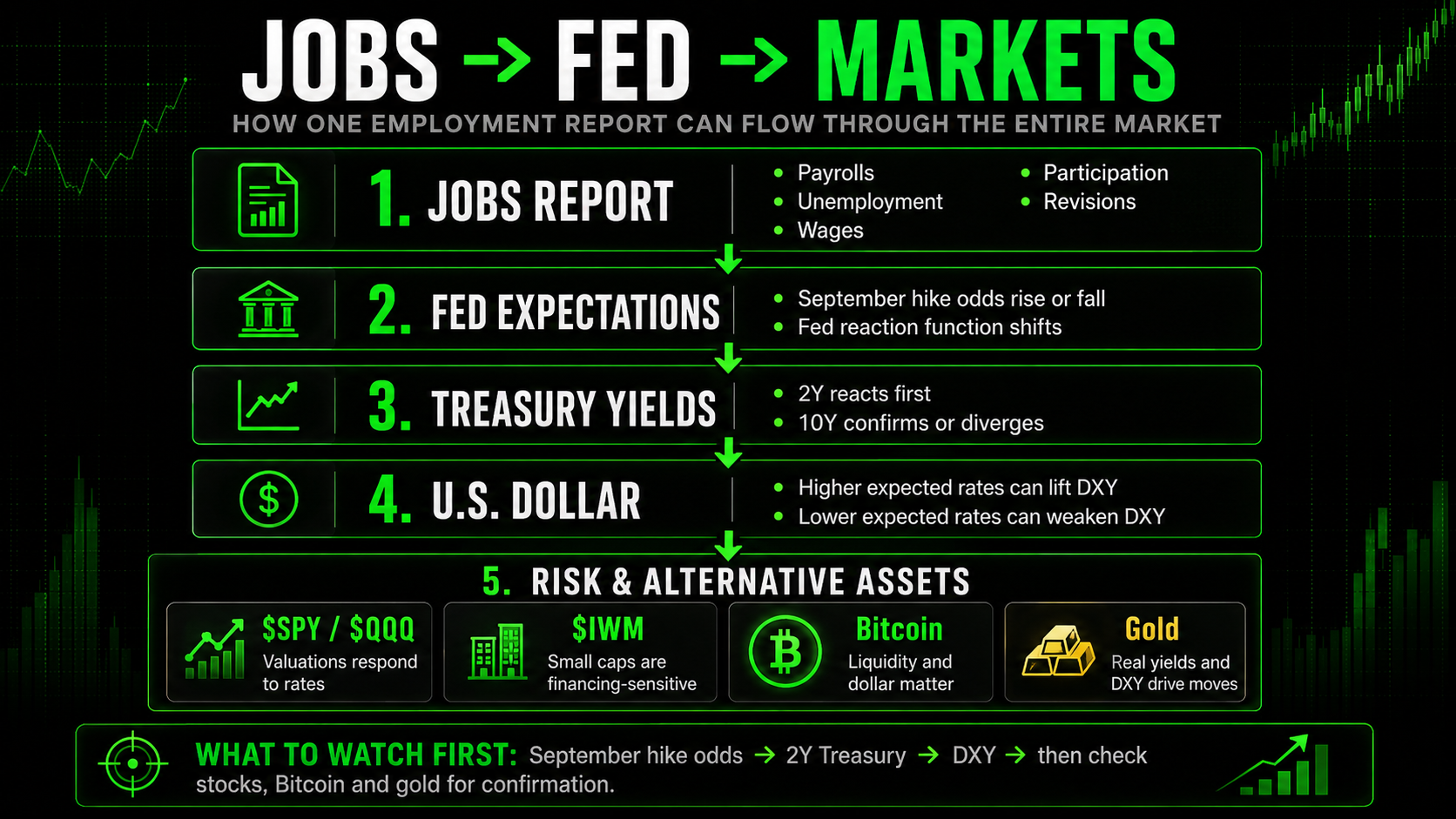
Watch the transmission chain.
First: Fed Funds Expectations
Did the probability of a September hike rise or fall?
Second: 2-Year Treasury Yield
This can tell you whether the rates market believes the data actually changed Fed policy.
Third: DXY
Is the dollar confirming the yield move?
Fourth: $QQQ and $IWM
Are rate-sensitive equities confirming?
Fifth: Bitcoin and Gold
Are alternative and liquidity-sensitive assets responding?
This cross-market confirmation can tell you much more than the headline payroll number alone.
Do Not Forget the Revisions
This may be the most overlooked number on jobs Friday.
Everyone will see the August payroll headline.
Far fewer people will immediately study what happened to June and July.
That can be a mistake.
The July report itself showed exactly why revisions matter.
May and June were revised down by a combined 103,000 jobs.
Imagine Friday says:
August: +70K
Sounds decent.
But then July gets revised from -23K to -60K.
Suddenly the underlying picture looks weaker.
Or imagine August prints +30K but previous months are revised sharply higher.
The headline might look disappointing while the broader trend improves.
That is why professional traders read beneath the first number.
Watch the Household Survey Too
Nonfarm payrolls come from the establishment survey.
The unemployment rate comes from a separate household survey.
Sometimes the two tell very different stories.
That happened in July.
Payrolls declined by 23,000, yet unemployment fell from 4.2% to 4.1%.
The reason was not an explosion in employment.
A large number of people left the labor force.
That makes August participation particularly important.
If the unemployment rate remains low because participation keeps declining, that is less encouraging than a low unemployment rate accompanied by a growing workforce.
The AI Question Is Starting to Reach the Labor Market
There is another issue worth watching.
Artificial intelligence is driving enormous capital investment.
At Jackson Hole, Warsh highlighted the potential for AI to materially increase US productivity.
But higher productivity can affect labor demand in different ways.
Companies may:
produce more with the same workforce, automate certain roles, redirect spending from labor toward technology, or create entirely new categories of employment.
Reuters noted that slower hiring may already reflect a combination of weaker business demand, retirements, immigration changes and increased AI adoption.
That does not mean AI caused July's employment decline.
The labor market is far too complex for that conclusion.
But the relationship between:
AI investment → productivity → hiring → wages → inflation → Fed policy
could become one of the defining macro themes of the next decade.
The Fed Still Gets One More Major Inflation Report
This is important.
Friday's jobs report can dramatically change the September Fed trade.
It cannot completely settle the September Fed decision.
The August Consumer Price Index is scheduled for September 11, five days before the FOMC announces its policy decision.
So the sequence is:
September 4: Jobs report
↓
September 11: CPI
↓
September 15-16: FOMC
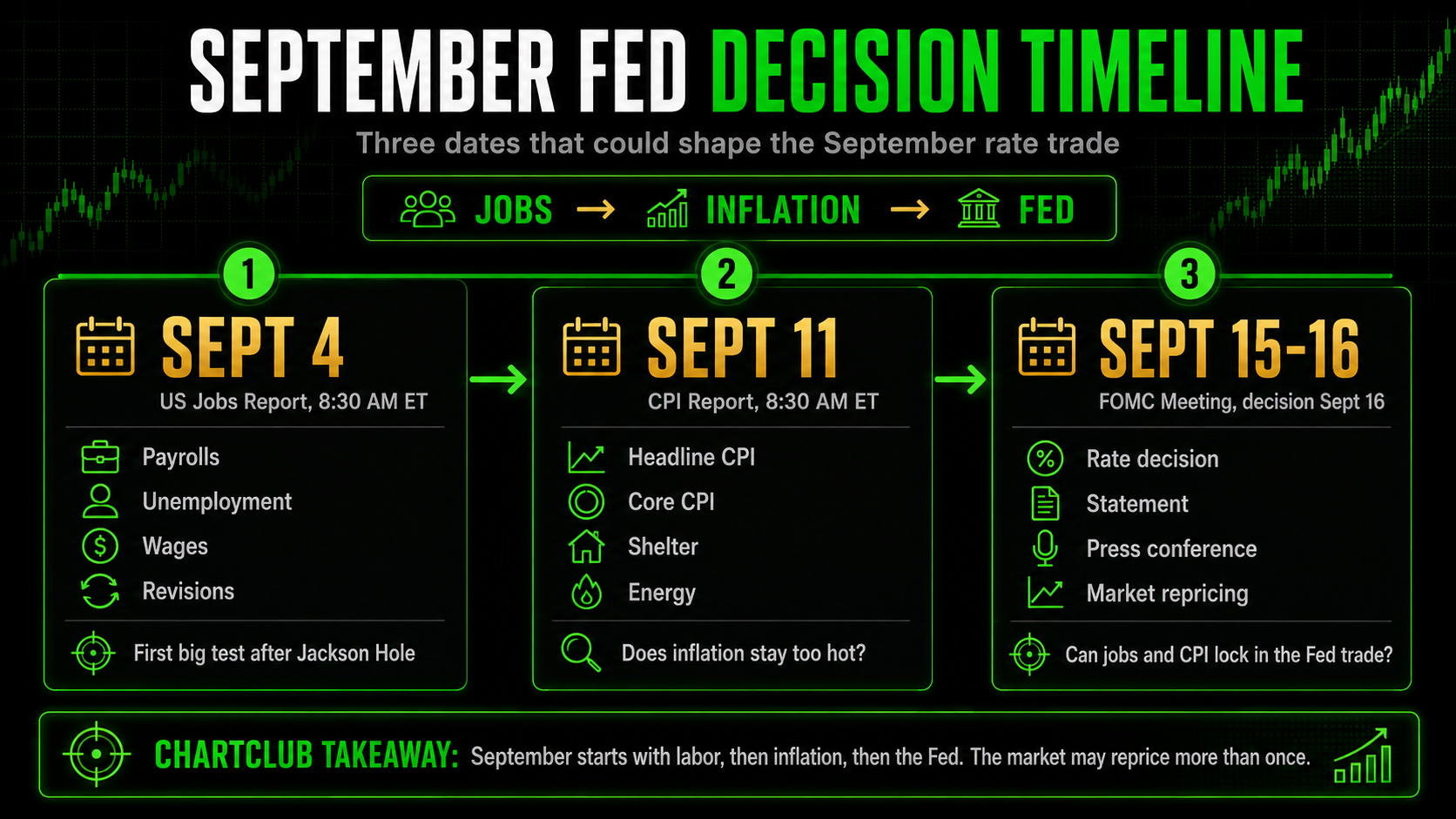
That means traders could experience two major policy repricings within one week.
Jobs may tell the Fed how much room it has to fight inflation.
CPI will tell it whether inflation actually requires another move.
What Would Make a September Hike More Likely?
The strongest case for another rate increase would probably involve a combination of:
Payroll growth rebounding Unemployment staying near 4.1% Participation improving Wage growth firming JOLTS showing stable employer demand Jobless claims remaining low August CPI staying hot
That would give the Fed a relatively straightforward argument:
The economy remains resilient, labor conditions are stable and inflation is still too high.
Under that scenario, Friday's current roughly 56% hike probability could move substantially higher.
What Could Kill the September Hike Trade?
The opposite setup would involve:
Another weak or negative payroll print Higher unemployment Further downward revisions Continued labor-force weakness Declining job openings Soft wage growth
followed by a softer August inflation report.
In that scenario, the Fed would need to ask whether raising rates to fight inflation risks unnecessarily accelerating labor-market weakness.
Markets could move quickly from debating:
"Will the Fed hike?"
to:
"Is the economy slowing faster than expected?"
That would be an entirely different September trade.
ChartClub Trading Framework for Jobs Friday
For traders, the objective is not to guess the payroll number on Thursday night.
It is to understand the setup before the data arrives.
When the report hits, ask four questions.
- What surprised?
Payrolls, unemployment, wages, participation or revisions?
- What happened to Fed expectations?
Did September hike odds materially change?
- Which market moved first?
The 2-year Treasury and DXY will often provide the cleanest macro read.
- Did risk assets confirm?
Watch $SPY, $QQQ, $IWM, $BTC and gold.
That is how a macro release becomes a tradable framework rather than a guessing game.
For Day Traders: The First Move Can Be Wrong
Jobs reports create the same problem we see during Fed decisions.
Algorithms react faster than people.
Payrolls hit.
Treasury futures move.
DXY reacts.
Equity futures move.
Crypto moves.
Then traders notice unemployment.
Then wages.
Then revisions.
Then participation.
The original move can reverse completely.
Suppose payrolls beat expectations.
$QQQ immediately sells.
But wage growth misses.
Unemployment rises.
Previous months are revised down.
The 2-year yield starts reversing.
Suddenly the supposedly "hot" jobs report is not actually very hot.
This is why there is no need to win the first 30-second candle.
Sometimes the better setup appears after the market has processed the entire report.
VWAP Becomes Especially Useful After the Open
By the time US equities open at 9:30 a.m. ET, markets will have had an hour to digest the employment report.
That creates a much more useful environment for technical analysis.
Suppose $QQQ gaps down because yields jumped.
Watch:
Does it remain below VWAP? Does the first bounce reject VWAP? Does volume confirm the rejection? Is DXY still strong? Is the 2-year still elevated?
If all of those remain aligned, the macro reaction may have real continuation.
If $QQQ quickly reclaims VWAP while Treasury yields and DXY reverse, the initial bearish interpretation may be failing.
The data creates the catalyst.
Price creates the setup.
Why This Report Matters for Investors Too
Long-term investors do not need to trade every employment report.
But they should understand what the labor data says about the economic regime.
If unemployment remains low while productivity and earnings remain strong, higher interest rates may be easier for the economy to absorb than many investors expect.
That could support:
quality equities, profitable technology, AI infrastructure, financials, and companies with strong cash flow.
If employment deteriorates while inflation stays elevated, the environment becomes much more difficult.
That combination can pressure:
consumer spending, credit quality, small companies, cyclical businesses, and highly leveraged balance sheets.
The jobs report is not simply about Friday morning.
It can help investors determine what kind of economy they are investing in.
The Bigger Question: Is the Labor Market Weak, or Just Different?
This might be the most interesting question of all.
Payroll growth has slowed dramatically.
But unemployment remains around 4.1%.
Initial claims remain near 200,000.
Layoffs are relatively contained.
Business investment is booming.
AI infrastructure spending is surging.
Immigration has slowed.
Labor-force participation is weak.
Retirements are reducing worker supply.
Companies appear cautious about hiring, but many are equally reluctant to fire.
That is not a traditional recessionary labor market.
It is not a traditional boom either.
It may be something in between.
A low-hiring, low-firing economy where companies become increasingly selective about adding workers while technology allows existing employees to become more productive.
If that continues, the Federal Reserve may have to rethink what "full employment" and "restrictive policy" actually look like.
The Market Setup Heading Into September
Everything is now connected.
Inflation is 3.7%. The Fed funds rate is 3.50% to 3.75%. The 2-year Treasury yield is around 4.36%. Markets price roughly a 56% chance of a September hike. July payrolls fell 23,000. Unemployment is 4.1%. Wage growth has cooled to 3.2%. Initial unemployment claims are just 203,000. Bitcoin finished Friday around $77,400. Gold suffered a roughly 3.2% daily decline. US stocks remain close to record territory despite a more hawkish Federal Reserve.
Something in that mix is going to have to move.
Friday's employment report may tell us what.
ChartClub Takeaway: Jobs Could Decide the Trade, Not the Entire Fed Decision
There is an important distinction here.
The August jobs report probably will not single-handedly determine what the Federal Reserve does on September 16.
August CPI still arrives afterward.
Fed officials will still debate the evidence.
Markets will still move.
But Friday can decide the September Fed trade.
A strong labor report could validate Warsh's hawkish Jackson Hole message and push yields, the dollar and rate-hike expectations higher.
A weak report could challenge the entire repricing.
That is why traders should not focus only on whether payrolls beat or miss a forecast.
Watch:
Payrolls. Unemployment. Wages. Participation. Revisions.
Then watch the market.
2-year Treasury. DXY. $SPY. $QQQ. $IWM. $BTC. Gold.
The number gets the headline.
The reaction tells you what actually matters.
Final Thoughts
Friday's employment report arrives at exactly the moment markets need it most.
Jackson Hole changed expectations.
Warsh told investors the inflation fight may not be finished.
Bond traders responded.
The dollar responded.
Bitcoin and gold responded.
Equities softened.
Now markets need to know whether the economy can actually withstand another rate increase.
If job creation rebounds and unemployment stays low, the Fed may have the room it needs to tighten.
If employment weakens again, policymakers face a much harder decision.
And if jobs deteriorate while inflation remains near 4%, the Fed may find itself staring at the scenario every central bank dislikes:
weakening growth with persistent inflation.
That is why this is more than another payroll Friday.
The August employment report could determine how traders price the Fed, Treasury yields, the dollar and risk assets for the first half of September.
The release comes at 8:30 a.m. ET on Friday, September 4.
Be ready before the number hits.
But do not assume you know the trade until the market reacts.
US Jobs Report FAQ When is the August 2026 US jobs report?
The August Employment Situation report will be released by the Bureau of Labor Statistics on Friday, September 4, 2026 at 8:30 a.m. ET.
What are economists expecting for August payrolls?
Current forecasts generally cluster around roughly 45,000 to 58,000 new jobs, with other estimates near 50,000. The range reflects unusually high uncertainty after July's surprise decline.
What happened to US payrolls in July?
Nonfarm payroll employment declined by 23,000 jobs in July. May and June payroll figures were also revised down by a combined 103,000.
What is the current US unemployment rate?
The unemployment rate was 4.1% in July 2026. However, labor-force participation declined to 61.4%, which helped reduce the unemployment rate.
What is the current Federal Reserve interest rate?
The Federal Reserve's target range is currently 3.50% to 3.75%.
What are the odds of a September Fed rate hike?
Following Kevin Warsh's Jackson Hole speech, futures markets priced approximately a 55.7% probability of a September hike, up from 35.4% beforehand. These probabilities can change rapidly as new economic data arrives.
Why does the jobs report affect stocks?
Employment data influences expectations for economic growth, corporate earnings and Federal Reserve interest rates. Stronger employment can support earnings but may also push yields higher if markets expect tighter Fed policy.
Why does the jobs report affect Bitcoin?
Bitcoin can react to changes in liquidity, Treasury yields and the US dollar. Strong labor data that increases rate-hike expectations can pressure BTC, while weaker data can sometimes provide liquidity-related support.
Why does the jobs report affect the US dollar?
Higher expected US interest rates can make dollar-denominated assets relatively more attractive, supporting the dollar against currencies such as the euro and Japanese yen.
When is the next Federal Reserve meeting?
The next FOMC meeting takes place September 15 to 16, 2026, with the policy announcement scheduled for September 16.
Sources
The core data in this article comes from official US government releases and current market reporting:
US Bureau of Labor Statistics: Employment Situation calendar and July labor-market data. BLS Employment Situation release schedule
US Bureau of Labor Statistics: Current JOLTS data and September release schedule. BLS Job Openings and Labor Turnover Survey
US Bureau of Labor Statistics: 2026 preliminary payroll benchmark revision. BLS preliminary benchmark revision
Federal Reserve: July FOMC decision and current 3.50% to 3.75% federal funds target range. Federal Reserve July 2026 FOMC statement
Federal Reserve: 2026 FOMC meeting calendar. Federal Reserve FOMC calendar
Reuters: July payroll decline, downward revisions and labor-force participation. Reuters July US employment report
Reuters: Post-Jackson Hole market reaction across Treasury yields, Fed expectations, stocks, the dollar, Bitcoin and gold. Reuters Jackson Hole market reaction
Reuters: Current week-ahead expectations for the August employment report. Reuters Wall Street Week Ahead
Reuters: July PCE inflation and September Fed expectations. Reuters inflation and Fed outlook
About ChartClub
ChartClub looks beyond individual headlines to understand how catalysts move across markets.
A jobs number can move Treasury yields. Treasury yields can move the dollar. The dollar can influence gold and Bitcoin. Interest-rate expectations can change how investors value stocks.
Understanding those relationships is what turns market news into useful market intelligence.
Trade. Swing. Invest.
Visit www.chartclub.io for market research, trading education, tools and the ChartClub community.
This article is for educational and informational purposes only. It is not financial advice, investment advice or a recommendation to buy or sell any security, cryptocurrency, commodity or financial instrument. Markets involve risk and past performance does not guarantee future results.